Підручник Англійська мова 8 клас - Калініна Л.В. - Генеза 2016 рік
Unit 2: Live and Learn
2.3. School Life: Here and There
Word Bank |
Phrase Bank |
Communication Box |
• to expel • mascot • departure • outfit • braces • to button • brand new • ridiculous garment • waistcoat • wide-brimmed straw hat • eccentric |
• to remove privileges from • to enroll sb at school • to go about in something • to lace shoes • to do up the button • to shriek with laughter • to look dignified • to lose one’s nerve com pletely • to take notice of some body |
• I can’t possibly… • How lucky you are! • With immense reluctance, … |
I. Now for it
Look at the pictures and say what school activities are more typical of school children in the US, Great Britain and Ukraine. Explain why you think so.

Example: I think rugby is a typical school activity in great Britain because it originated there.
II. Reading
1. Read the story «Getting Dressed for Big School» and say if the boy liked his uniform.
Getting Dressed for Big School Part One
When I was twelve, my mother said to me, «I’ve enrolled you at Marlborough and Repton. Which would you like to go to?»
Both were famous Public Schools, but that was all I knew about them. «Repton», I said. «I’ll go to Repton». It was an easier word to say than Marlborough.
«Very well», my mother said. «You’ll go to Repton.»
We were living in Kent then. Repton was up in the Midlands, near Derby, and some 140 miles away to the north.
On the day of my departure, I had to get dressed for the part. I had been to London with my mother the week before to buy the school clothes, and I remember, how shocked I was when I saw the outfit which I was expected to wear.
«I can’t possibly go about in those!» I cried. «Nobody wears things like that!»
«Are you sure you haven’t made a mistake?» my mother said to the shop assistant.
«If he’s going to Repton, madam, he must wear these clothes», the assistant said firmly.
And now this amazing fancy dress was all laid out on beside my bed waiting to be put on. «Put it on», my mother said. «Hurry up or you’ll miss the train».
«I’ll look like a complete idiot if I put it on», I said. My mother went out of the room and left me to it. With immense reluctance I began to dress.
Part Two
First there was a white shirt with a detachable white collar. Around the collar I tied a black tie, using an ordinary tie knot.
Then came the trousers and the braces. The trousers were black with thin grey lines running down them. I buttoned the braces on to the trousers, six buttons in all, then I put on the trousers and fixed the braces to the correct length.
I put on a brand new pair of black shoes and laced them up.
Now for the waistcoat. This was also black and it had twelve buttons down the front and two little waistcoat pockets on either side, one above the other. I put it on and did up the buttons, starting at the top and working down.
All this was bad enough for a boy who had never before worn anything better than a pair of shorts and a blazer. But the jacket put the lid on it. It wasn’t actually a jacket, it was a sort of tailcoat, and it was without a doubt the most ridiculous garment I had ever seen. Like the waistcoat, it was jet black and made of a heavy material. In the front the two sides of it met only at the point. Here there was a single button and this had to be done up. From the button downwards, the lines of the coat separated and came together again at the backs of the knees, forming a pair of «tails». Besides, when you walked, these tails flapped against your legs. Feeling like an undertaker’s apprentice in a funeral parlour, I crept downstairs.
My sisters shrieked with laughter when I appeared. «He can’t go out in those!» they cried. «He’ll be arrested by the police when they see him!»
«Put your hat on», my mother said, handing me a stiff wide-brimmed straw hat with a blue and black band around it. I put it on and did my best to look dignified. The sisters fell all over the room laughing.
My mother got me out of the house before I lost my nerve completely and together we walked through the village to the station.
«Nobody’s taking the slightest notice of you», my mother said as we walked through High Street.
And curiously enough nobody was.
«I have learnt one thing about England», my mother went on. «It’s a country in which men love to wear uniforms and eccentric clothes. Two hundred years ago their clothes were even more eccentric than they are today. Think how lucky you are. You don’t have to wear a wig on your head and ruffles on your sleeves!»
«I still feel stupid,» I said.
(Adapted from Roald Dahl «Getting Dressed for the Big School»)
Across Cultures: Great Britain
Marlborough — a town in south-west England known for the famous public school, Marlborough College, established in 1843.
Repton — a town in the heart of England, South Derbyshire, also known for the famous public school, Repton School, established in 1559.

Kent — a county in south-east England, known as the «Garden of England» because of its fruit and vegetable crop.

The Midlands — the central parts of England, an important area for light engineering industries.

Derby /da:bi/ - a city in Derbyshire famous for its industries (engineering and china) and a very important yearly horse race held in Epsom in England in May or June, on a day which is known as Derby Day.

III. Language Track

1. From the text above, reproduce 10 words with the letter ’u’ which is pronounced as /v/, /ju:/ or /ʌ/. Practise saying some of them in your own sentences.
Example: /ju:/ uniform
Ukrainian school children are supposed to wear school uniforms. I think not only Ukrainian kids. Uniforms are typical of British schools, too, I believe.

1. Study the difference in meaning. Reproduce these phrases from the text in their context and interpret their meaning. Make up your own sentences with them.
beside — next to or very close to the side of someone or something. |
besides - used when adding another reason or in addition to something or someone else |
Example: The boy came up and sat beside me. |
that you are mentioning. Examples: Besides, they choose electives. Beside myself, there are two more Americans. |
2. From the text above, reproduce words/phrases which relate to school clothes.
Comment on the boy’s attitude to them.
Example: «How shocked I was when I saw the outfit which I was expected to wear.» The outfit consisted of a white shirt with a detachable white collar. Around the collar the boy tied a black tie, using an ordinary tie knot. Then came the trousers and the braces… He thought that he looked like an idiot in them…
3. In the text above, find words and phrases which convey positive and negative feelings. Reproduce them in their contexts and develop the ideas.
Positive feelings |
Negative feelings |
to shriek with laughter |
to be shocked |
Example: The boy was shocked when he saw his school clothes. He felt stupid in them but he had to wear them because he was going to Repton School.

1. In the text above, find and reproduce the sentences with if / when clauses and interpret their meanings.
2. Say what clothes you will wear if / when:
• you go to school on Saturday;
• you are going to the gym;
• you want to impress someone;
• if you are going to see a school play.
Example: If I go to school on Saturday, I will wear something casual, like jeans and a jacket.

1. Complete the sentences about what will happen to you under certain conditions in the future.
Example: If I do well on my test,_____________
If I do well on my test, I’ll get a high grade.
1. If I campaign for school president, …
2. What will you do after school if …
3. If the education system improves, …
4. If I get a summer job, …
5. If you are going to become an interpreter, …
6. I’ll stay after classes if …
IV. Communication Track
1. Speaking
a) Look at the picture and describe the boy’s uniform as if you were the main character of the story. Use the word list below. Say how you would feel if you had to wear such eccentric clothes.
to be enrolled at Repton; amazing fancy dress; a white shirt with a detachable collar; to tie a black tie; to button braces on the trousers; to lace shoes up; the most ridiculous garment; eccentric clothes.

b) In pairs, discuss pluses and minuses of wearing school uniform. Use the pattern below.
Pattern
- I say … what do you think of … at school?
- I’m quite positive about it. A uniform instills discipline and gives you a feeling … .
- But how can you express your individuality if … ?
- But when children are dressed in the same uniform nobody … .
- I see your point. But isn’t it boring to … ?
- I believe children should concentrate on … but not on their classmates’ clothes.
- Right. But if I look funny in it and it doesn’t … . Isn’t it better … ?
- Maybe. You know that in the most schools pupils in America and Britain … . It helps them to … . Besides, it is easy to say which school … .
- They … traditionally. But in some modern schools … .
- I won’t argue with you. To each his own.
3. In the whole group, read the encyclopedia entry about school uniform and discuss how you would edit it using the story and your own experience. Give your illustrations.
A school uniform is an outfit - a set of standardized clothes - worn primarily for an educational institution. They are common in primary and secondary schools in many nations. When used, they form the basis of a school’s dress code.
Traditionally, school uniforms have tended to be subdued and professional. Boys’ uniforms often consist of dark short or long trousers and a light- coloured shirt, often with a tie. Girls’ uniforms vary greatly between countries and schooling systems, but typically consist of a dress or a blouse worn either with a skirt or culottes or under a pinafore. In some countries, gender- specific uniforms have been a point of contention, with some schools permitting female students to choose either skirts or trousers while still requiring male students to wear trousers. The use of a blazer or suit-like jacket for either gender is also fairly common, especially in countries with relatively cold weather.
2. Listening
a) Before you listen
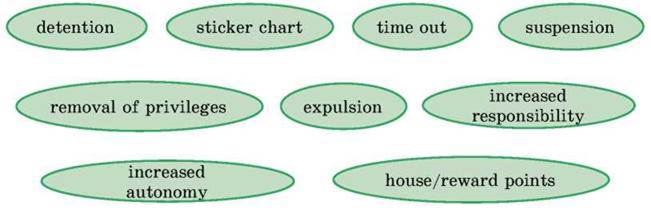
You are going to listen to a teacher talking about punishing and rewarding in British schools. Say which ways are used in Ukrainian schools.
b) While you listen
Listen to the teacher’s talk and say which of these words stand for rewards and which - for punishment. Give context for the following words.
a) Say which ways are used in Ukrainian schools.
c) After you listen
Say what advice you would give to a new pupil on reward and punishment schemes in your school.
3. Writing
a) Before you write
• Brainstorm with your friends what school problem can represent common subjects of advice seeking letters to a teenagers’ magazine.
• Make a list of words/phrases you’ll use to formulate them.
b) While you write
• If you want to ask for professional help on a school problem, write an informal letter of complaint to your school counsellor. Follow the format of the letter below.
How to write a letter of complaint to your school counsellor
Content Tips |
Language Tips |
• Address your school counselor. • Explain the reason for writing in the first paragraph. • In the following paragraph, expand on the problem. • Give at least two options for a solution and ask for help from the addressee on choosing the best solution. • Sign with your name or an assumed name for privacy. |
• Dear Miss/Ms/Mr… (name of the school counsellor), • I have a situation for which I need … . • So I’m writing you in hopes you can give me … . • The problem is that … . • To complicate matters, … . • I very much would like to … . • What should I do? Should I … or …? • Please answer as soon as possible because this needs to be resolved quickly. • Mistreated student (assumed name) |

At Home: In your WB, write a letter of complaint to your school consellor about a school problem.
Перша публікація: 01/01/2016
Останнє оновлення: 31/12/2023
Редакційна та навчальна адаптація: Даний матеріал зведено на основі першоджерела/оригінального тексту. Команда проєкту здійснила редакційне оглядове опрацювання, виправлення технічних неточностей, структурування розділів та адаптацію змісту до навчального формату.
Що було опрацьовано:
- усунення форматних дефектів (OCR-помилки, розриви структури, дефектні символи);
- редакційне упорядкування змісту;
- уніфікація термінів відповідно до академічних джерел;
- перевірка відповідності фактичних тверджень тексту першоджерела.
Усі згадки про автора, рік видання та походження первинного тексту збережено відповідно до джерела.