Підручник Англійська мова 7 клас (8-й рік навчання) - Алла Несвіт - Генеза 2016 рік
UNIT 4 Listening to Music
Lessons 5-6. Musical Instruments
1. a) Work in pairs. Read and choose the correct item to complete the sentences.
1. Jazz started among …..
a) slaves from West Africa
b) farmers from Ireland
c) painters from Cuba
2. A popular type of music in which the words are spoken, not sung, is called …..
a) tap b) rap c) step
3. The music of Bach, Beethhoven, and Mozart is called …… music.
a) antique b) traditional c) classical
4. Traditional music played by the ordinary people is called …… music.
a) folk b) free c) simple
5. The traditional Black American music is called …… Many of these songs are about how difficult life is.
a) gospel b) reggae c) blues
6. The Beatles invented the new style of music called ……
a) heavy metal b) beat c) rock and roll
b) Listen and check your answers.
2. Work in pairs. Take turns to ask and answer the questions. Add information.
Example:
A: When do you listen to music?
B: I listen to music almost every day.
A: What’s your favourite kind of music?
B: I love rap. I have 20 rap CDs. What about you?
A: I love all kinds of music - rap, jazz, rock, classical, and folk.
Questions |
You |
Your Friend |
When do you listen to music? What’s your favourite kind of music? Who is your favourite musician? Do you usually listen to music on the radio, on TV, on CDs, or at concerts? Can you play any musical instrument? If so, which one? … |
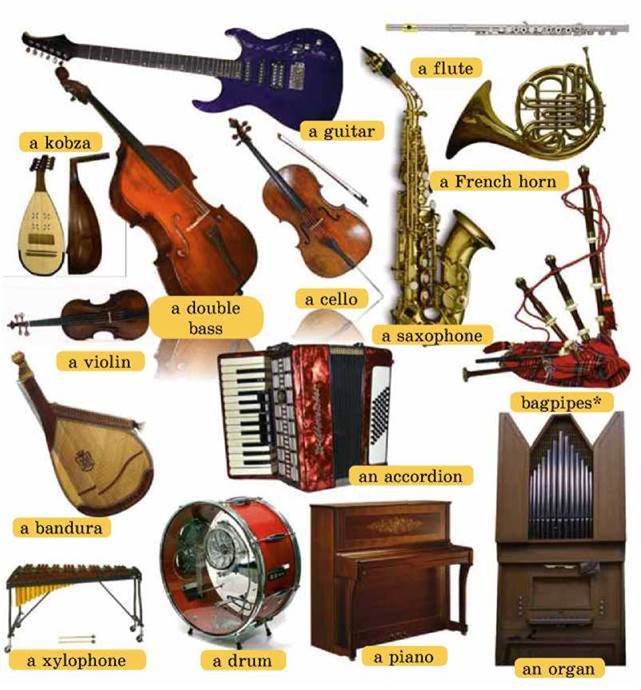
b) Look at the pictures again. Write the names of the instruments under the correct heading.
1. Stringed Instruments: Instruments that have strings.
2. Wind Instruments: Instruments that we blow.
3. Percussion Instruments: Instruments that we hit.
4. Keyboard Instruments: Instruments that have ’keys’.
c) Work in pairs. Compare your lists with each other.
4. a) Read what children say about the musical instruments they play. Match their stories (1-4) to the photos (A-D).
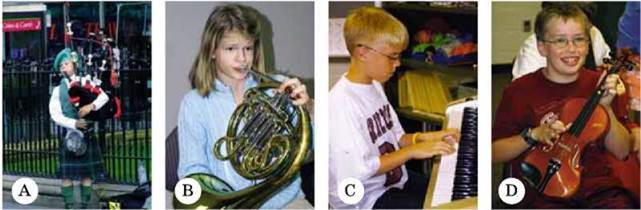
1. Hello! I am Susan. I live in Manchester, England. I love music and learn to play the French horn. This is a wind instrument which is made of special tubes. I might become a famous musician in future.
2. Hello! I’m Brian. I am practising on the violin. This is my second year of learning. This musical instrument produces wonderful sounds. Different violins have different sounds. The material the instrument is made of is important. The way the instrument is made change the sound. This one must be created by a real professional.
3. Hi! I’m Bill. My mum has always wanted me to play the piano. She says that it is one of the best instruments. Many famous composers played it. You can play different styles of music on it. I started playing the piano three years ago. My mum is sure I will participate in an international contest one day.
4. Hi! My name is Mark. I am from Scotland. I started playing the bagpipes when I was five. The bagpipes are the Scottish national musical instrument. The sound they make is unusual, but the music is good for dancing. So I have been playing the bagpipes for six years. I believe I should go to a music school and have more lessons. Then I may take part in Edinburgh Military Tattoo one day.
b) Read the statements and say what musical instrument it is.
1. The sound of this musical instrument is unusual, but it is good for dancing.
2. This is a wind instrument made of special tubes.
3. The material this musical instrument is made of changes its sound.
4. This is a common keyboard musical instrument. Many children learn to play it.
Grammar Lab: Modal Verbs
Modal verbs are auxiliary verbs - they are used with other main verbs. Modal verbs are can, could, will, would, may, might, shall, should and must.
Modal verbs show the speaker’s attitude or feelings about a situation. The same modal verb can be used in different meanings, depending on the situation.
Certainty and uncertainty
100% |
certainty |
will |
95% - 100% |
deduction |
must, can’t |
80% |
expectation |
should |
30% - 70% |
uncertainty |
may, might, could |
0% |
certainty |
won’t |
We use will and won’t when we are certain about something in the future.
We use must and can’t when we know something is certain because it is logical, or when we make an assumption because of the facts of the situation.
We use should when we expect that something will happen.
We use may, might and could when we are uncertain.
5. Find the sentences with modal verbs in of Ex. 4a on p. 98 and explain how they change the meaning of the main verb. Use the notes from the table given above.
Example:
I might become a famous musician in future.
(The person is 30% sure about what he is saying. It is difficult to predict what can happen in a few years’ time.)
6. Work in groups. The speaker says a sentence on the topic «Music and Musical Instruments». The others use the modal verbs to give a new shade of meaning to it. Practise the same sentence with different modal verbs and explain how different they become.
7. Speak in class. Talk about the musical instrument you / your friend play(s). How long have you been practising? Use Ex. 4 on p. 98 as a model.
8. Write different types of questions to the sentences given below.
1. He wants to become a pop star.
2. Music helps people to express themselves.
3. I have always dreamt of playing the piano.
4. We enjoy our traditional folk music.
5. My favourite group has already recorded a new album.
6. I’m going to participate in the school concert.
Перша публікація: 01/01/2016
Останнє оновлення: 31/12/2023
Редакційна та навчальна адаптація: Даний матеріал зведено на основі першоджерела/оригінального тексту. Команда проєкту здійснила редакційне оглядове опрацювання, виправлення технічних неточностей, структурування розділів та адаптацію змісту до навчального формату.
Що було опрацьовано:
- усунення форматних дефектів (OCR-помилки, розриви структури, дефектні символи);
- редакційне упорядкування змісту;
- уніфікація термінів відповідно до академічних джерел;
- перевірка відповідності фактичних тверджень тексту першоджерела.
Усі згадки про автора, рік видання та походження первинного тексту збережено відповідно до джерела.