Підручник Англійська мова 7 клас (8-й рік навчання) - Алла Несвіт - Генеза 2016 рік
UNIT 4 Listening to Music
Lessons 3-4. Music Styles
1. Many people listen to music while doing other things. Do you? Read and complete the chart.
Situation |
You |
Your Friend |
You’re studying. You’re exercising. You’re eating. You’re having a break at school. You’re having a shower. Other |
2. Work in pairs. Talk about the styles of music you listen to while doing other things. Use the words from the box of Ex. 2 on p. 90.
Example:
A: What kind of music do you like to listen to when you’re studying?
B: It depends on my mood. Sometimes I listen to jazz, and sometimes I listen to rap. What about you?
A: I usually listen to classical music. But sometimes I don’t listen to music. I listen to news.
3. Look at the photos on page 93 and listen to the information. Fill in the gaps. Who does the speaker talk about? Why is he impressed by the songs of this singer?

b) Use the facts in the table to talk about these popular Ukrainian singers.
4. a) Read about different styles of popular music. Say which of them you listen to.
Pop Styles
✵ The Blues: traditional Black American music. ’Blue’ means ’sad’, and many blues songs are about how hard life is.
✵ Gospel: originally sung by African slaves. The happy, emotional songs are still heard in churches in the southern USA.
✵ Rhythm and Blues: black workers in the USA moved from farms to cities. They mixed the Blues with Gospel and played it with electric guitars - this became ’rhythm and blues’.
✵ Country and Western: the music of poor white Americans in the 1930s and 1940s. It is still the most popular music in the southern USA.
✵ Rock and Roll: white teenagers in the 1950s discovered rhythm and blues, but many radio stations would not play ’black’ music. Elvis Presley was one of the first singers to mix rhythm and blues and country and western. The result was ’rock and roll’.
✵ British Beat: the Beatles in the 1960s mixed rhythm and blues, rock and roll, and soul music. The new style was ’beat’ music. Groups used drums, bass and two guitars with vocal lead and harmony.
✵ Heavy Metal: a style based on blues and rhythm and blues, but with the electric instruments amplified so they are very loud.
✵ Reggae: this started in Jamaica and is a mixture of music from African roots and rhythm and blues. Bob Marley made it popular.
✵ Rap: in the 1980s DJs in American clubs began half singing and half talking over instrumental records. This is called ’rap’. West African speech rhythms survive in rap.
✵ Jazz: an American musical art form which originated around the beginning of the 20 th century in African American communities in the southern United States from a confluence of African and European music traditions.
b) Work in pairs. Ask and answer the questions.
1. Where did ’rhythm and blues’ start?
2. Who was one of the first ’rock and roll’ singers?
3. What styles did The Beatles mix to create the British Beat Music?
4. Who made ’reggae’ popular?
5. When did ’rap’ start?
6. What kind of music is ’jazz’?
5. Look at the photos and say what styles of music they are associated with.
Example:
Picture A is associated with the British Beat.
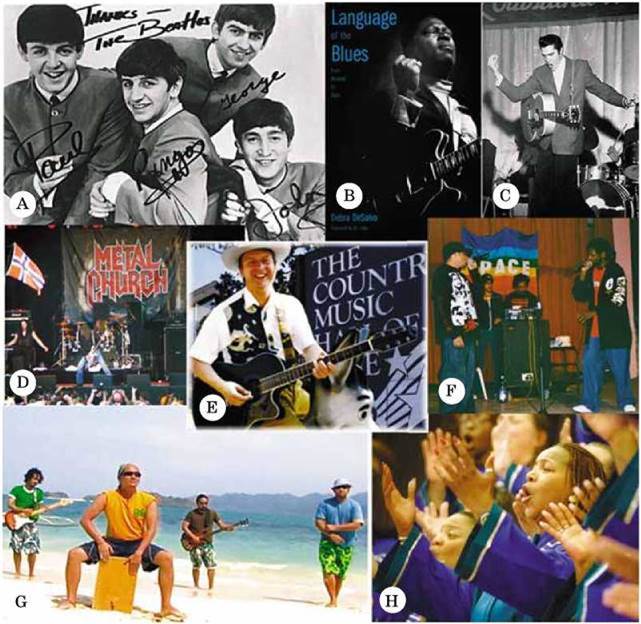
6. Listen to different styles of music. Match them to the styles described in the text of Ex. 4a on p. 93.
Conversation Lab: Talking about Music
I’m into jazz.
I’m a great / big fan of pop.
This tune is enchanting.
This melody makes me feel better.
This style arises positive emotions in my soul.
In my opinion, this style of music is hard to listen to.
This rhythm affects my nerves.
It sounds like nothing I’ve ever heard before.
7. Work in groups. Give your opinion about the music. Take notes. Report to the class about the most popular kind of music in your group.
Example:
A: I love heavy metal.
B: So do I.
C: I don’t, I think it’s horrible.
8. Read and act out the situation.
You are giving an interview about music styles. Tell the reporter where these styles come from, what styles in music you personally like and why.
9. Put the verbs in brackets into the correct tense form and voice.
1. I ….. (to ask) at the music lesson tomorrow.
2. We ….. (to tell) a lot about the life of famous Ukrainian composer M. Lysenko by our teacher of music at the previous lesson.
3. Our musical dictations …… (usually / to check) by our teacher.
4. The name of this composer ….. (seldom / to mention) in our country.
5. The girl ….. (not / to allow) to go to the concert.
6. The way to the nearest concert hall (to show) me by the Londoner.
Перша публікація: 01/01/2016
Останнє оновлення: 31/12/2023
Редакційна та навчальна адаптація: Даний матеріал зведено на основі першоджерела/оригінального тексту. Команда проєкту здійснила редакційне оглядове опрацювання, виправлення технічних неточностей, структурування розділів та адаптацію змісту до навчального формату.
Що було опрацьовано:
- усунення форматних дефектів (OCR-помилки, розриви структури, дефектні символи);
- редакційне упорядкування змісту;
- уніфікація термінів відповідно до академічних джерел;
- перевірка відповідності фактичних тверджень тексту першоджерела.
Усі згадки про автора, рік видання та походження первинного тексту збережено відповідно до джерела.