Підручник Англійська мова 7 клас (8-й рік навчання) - Алла Несвіт - Генеза 2016 рік
UNIT 3 Books and Writers
Lesson 9. The British Writers
1. Look at the pictures. Say whom of these English writers you know. Which of their literary works have you read?
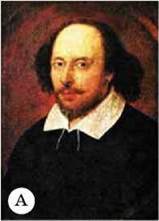
William Shakespeare

Robert Burns

Sir Arthur Conan Doyle

Rudyard Kipling
Reading Lab
2. Read the text and answer the questions.
1. Why is Robert Burns honoured as a national poet of Scotland?
2. When and where was he born? What was his childhood like?
3. Where did the poet get his education?
4. What role did the boy’s father play in his life?
5. What movement in literature does he belong to?
6. Which of his poems and songs are well-known today?
Robert Burns
Robert Burns (January 25, 1759 - July 21, 1796) is the Scotland’s favourite son. He was a poet and a lyricist. Nowadays his birthday, the 25th of January, is celebrated as a national holiday in Scotland.
The poet was born in Ayre, and was the eldest of the seven children in a family. He had little regular schooling, and got much of his education from his father, who taught his children reading, writing, arithmetic, geography, and history, and also wrote for them A Manual of Christian Belief.
Robert had a very difficult life. By the age of fifteen Robert Burns was the main helper to his father on a farm. That was the time when he started writing his poems. He had a chance to study only when the harvesting season was over.
Robert Burns is regarded as a pioneer of the Romantic Movement* in literature. As well as making original compositions, Burns also collected folk
songs from across Scotland. He often revised or adopted them. His poem (and song) Auld Lang Syne is often sung at Hogmanay* (New Year). Some other poems and songs by R. Burns that remain well-known across the world today, include A Red, Red Rose, A Man’s A Man for A’ That, My Heart’s in the Highlands.
3. Look at the pictures of the Highlands of Scotland and describe them. Use the words:
Nouns |
A hill, a waterfall, a valley, a peak, a lake, nature, a stream, the sky, a view, a mountain. |
Adjectives |
Woody, enchanting, snowy, breathtaking, picturesque, clear, marvellous, fabulous, scenic. |

4. a) Listen and read the poem by Robert Burns.
MY HEART’S IN THE HIGHLANDS
My heart’s in the Highlands, my heart is not here,
My heart’s in the Highlands a-chasing the deer,
A-chasing the wild deer and following the roe -
My heart’s in the Highlands, wherever I go!
Farewell to the Highlands, farewell to the North,
The birthplace of valour, the country of worth!
Wherever I wander, wherever I rove,
The hills of the Highlands forever I love.
Farewell to the mountains high cover’d with snow,
Farewell to the straths and green valleys below,
Farewell to the forests and wild-hanging woods,
Farewell to the torrents and long-pouring floods!
My heart’s in the Highlands, my heart is not here,
My heart’s in the Highlands a-chasing the deer,
A-chasing the wild deer and following the roe -
My heart’s in the Highlands, wherever I go!
By Robert Burns
b) Work in pairs. Ask and answer the questions.
1. Does the poem help you to imagine the author’s native land?
2. What words does he use to describe it?
3. How does he express his love to his native land?
Conversation Lab
5. Speak in class. Talk about Robert Burns and his poems.
6. Put the words in brackets into the correct tense form.
1. The story ….. (to make) into a film last year.
2. The book ….. (to return) to the library tomorrow.
3. The biography of this writer ….. (to study) by many scientists in future.
4. Young William Shakespeare ….. (to learn) to read Latin and Greek, and he ….. (to study) the Roman classics.
5. «To be or not to be; that is the question,» ….. (to be) a well-known phrase by William Shakespeare, but many facts about his life (to remain) a mystery.
6. ….. you ….. (to read) any poems by Robert Burns?
Перша публікація: 01/01/2016
Останнє оновлення: 31/12/2023
Редакційна та навчальна адаптація: Даний матеріал зведено на основі першоджерела/оригінального тексту. Команда проєкту здійснила редакційне оглядове опрацювання, виправлення технічних неточностей, структурування розділів та адаптацію змісту до навчального формату.
Що було опрацьовано:
- усунення форматних дефектів (OCR-помилки, розриви структури, дефектні символи);
- редакційне упорядкування змісту;
- уніфікація термінів відповідно до академічних джерел;
- перевірка відповідності фактичних тверджень тексту першоджерела.
Усі згадки про автора, рік видання та походження первинного тексту збережено відповідно до джерела.