Підручник Англійська мова 7 клас (8-й рік навчання) - Алла Несвіт - Генеза 2016 рік
UNIT 3 Books and Writers
Lessons 7-8. Taras Shevchenko
1. Work in pairs. Look at the pictures. Say what you know about these Ukrainian writers and their literary works.
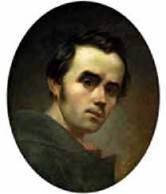
Taras Shevchenko

Ivan Franko
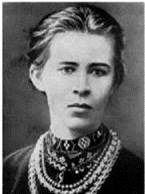
Lesia Ukrainka
2. Read the text about Taras Shevchenko. Say what facts in his biography impressed you most.
Taras Shevchenko
A brilliant Ukrainian poet and artist Taras Hryhorovych Shevchenko (March 9, 1814 - March 10, 1861) was born in the village of Moryntsi in the family of serfs. He lost his mother at the age of nine. Though his father was a shepherd, he could read and write and it was possible for him to teach his children. Taras’s childhood was very hard. When Taras was eleven, his father died. So, the boy was orphaned and grew up in poverty and misery. The boy had a special talent for drawing. At the age of 14 he became a servant («a houseboy») in the house of his owner, P. Engelhardt. P. Engelhardt noticed Shevchenko’s artistic talent and apprenticed him to the painter V.V. Shyriayev for 4 years. At that time he met the Russian painter K. Bryulov.
K. Bryulov painted the portrait of the Russian poet V. Zhukovskiy and sold it for 2500 roubles. The money was used to buy Shevchenko’s freedom from P. Engelhardt in 1838. Shevchenko was admitted to St. Petersburg]! Academy of Arts where he studied under K. Bryulov.
T. Shevchenko’s literary activity began in 1838. In 1840 he published his first collection of poems «Kobzar».
Taras Shevchenko has an important place in the Ukrainian history. He was the founder of the new Ukrainian literature. He established Ukrainian as the national literary language.
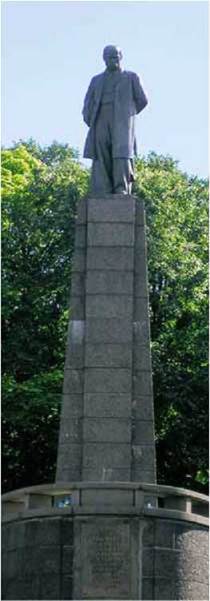
It’s interesting to know that there is a monument to T. Shevchenko in Washington D.C., the USA.

3. Work in pairs. Take turns to ask and answer the questions.
1. When and where was T. Shevchenko born?
2. Was he orphaned in his early teens?
3. Why did he grow up in poverty and misery?
4. What happened to Taras when he was 14 years old?
5. What did P. Engelhardt notice?
6. How did T. Shevchenko become free?
7. Where was he admitted in St. Petersburgh?
8. What book did he publish in 1840?
9. What is Shevchenko’s role in the history of the Ukrainian literature?
4. Look through the text of Ex. 2 on page 74 and say what you have learnt about these people: P. Engelhardt, K. Bryulov, V. Zhukovskiy.
Reading Lab: Jigsaw Reading
5. Work in groups. Read Taras Shevchenko’s poems in English and do the tasks. Can you recite these poems in Ukrainian?
Group A:
Kobzar
Translated by John Weir (1961)
The mighty Dnieper roars and bellows,
The wind in anger howls and raves,
Down to the ground it bends the willows
And mountain-high lifts up the waves.
The pale-faced moon picked out this moment
To peek out from behind a cloud,
Like a canoe upon the ocean
It first tips up and then dips down.
The cocks have not proclaimed the morning,
There’s not a sound as yet of man,
The owls in glades call out their warnings,
And ash-trees creak and creak again.
1838
Questions:
1. For what reason do you think the poet wrote this poem?
2. How does Taras Shevchenko describe the Dnipro River?
3. What is the weather like in the poem?
4. What helps you see the picture of the Ukrainian nature?
5. What feelings does the poem awaken in readers?
6. Why do you think the poet wanted to describe this particular state of the Dnipro River?

Group B:
Testament
Translated by John Weir
When I die, pray, bury me
In my beloved Ukraine,
My tomb upon a grave mound high
Amid the spreading plain,
So that the fields, the boundless steppes,
The Dnieper’s plunging shore
My eyes might see, and my ears hear
The mighty river roar.
When from Ukraine the Dnieper bears
Into the deep blue sea
The blood of foes… then will I leave
These hills and fertile fields -
I’ll leave them all and fly away
To the abode of God,
And then I’ll pray… But till that day
I nothing know of God.
Oh bury me, then rise ye up
And break your heavy chains
And water with the tyrants’ blood
The freedom you have gained.
And in the great new family,
The family of the free,
With softly spoken, kindly word
Pray, men, remember me.
[1845]
(Taken from Taras Shevchenko. Selected Works : Poetry and prose. Progress Publishers, Moscow, [1964])
Questions:
1. For what reason do you think the poet wrote this poem?
2. Which words in the poem show that the poet really loved his Motherland?
3. What future did he pray for his countrymen?
4. What kind of a country was the poet dreaming of?
5. Did he believe that people could gain their freedom?
6. Why should people fight for freedom?
7. Why do you think this poem was translated into more than 150 languages?
Listening Lab
6. a) Listen to the text about T. Shevchenko’s works. Choose and tick the statements T (True) or F (False).
__ 1. «Kobsar» is the name of his second small collection of poems.
__ 2. His poem «Gaydamaky» was based on the Ukrainian historical themes.
__ 3. In his poems he depicted the mother as the most wonderful sacred person on the Earth.
__ 4. He wrote of his hatred to any oppression.
__ 5. T. Shevchenko described old themes and images in Ukrainian literature.
__ 6. He wrote about things that were quite usual for those days.
b) Listen to the text again and complete the sentences.
1. «Kobzar» is ….
2. He wrote a ballad …..
3. It was a tragic story of ….. who had been seduced1.
4. In his poems he wrote of his love for homeland and …..
5. …. that’s why he is a national poet, a poet of the people.
6. ….. wrote of the fight for spiritual freedom.
7. T. Shevchenko brought completely new …..
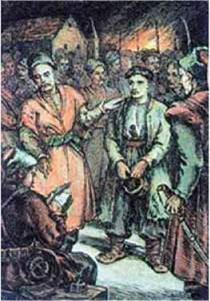
7. Speak in class. Talk about Taras Shevchenko and his poems. Say what your favourite poems are.
8. Complete the sentences. Use the past continuous form of the verbs.
1. A: What were you doing when I saw you yesterday?
B: I ….. (to talk) to the librarian.
2. Dan: Who ….. (you / to talk) when I phoned you?
Steve: It was my brother. He ….. (to tell) me about the book he read.
3. A: ….. (you / to watch) TV when I called you last night?
B: No, I wasn’t. I ….. (to read) a magazine.
4. A: …… (you / to play tennis) yesterday afternoon?
B: No, I …… (not / to play) tennis, I ….. (to do) my homework.
1 Had been seduced - була зваблена.
Перша публікація: 01/01/2016
Останнє оновлення: 31/12/2023
Редакційна та навчальна адаптація: Даний матеріал зведено на основі першоджерела/оригінального тексту. Команда проєкту здійснила редакційне оглядове опрацювання, виправлення технічних неточностей, структурування розділів та адаптацію змісту до навчального формату.
Що було опрацьовано:
- усунення форматних дефектів (OCR-помилки, розриви структури, дефектні символи);
- редакційне упорядкування змісту;
- уніфікація термінів відповідно до академічних джерел;
- перевірка відповідності фактичних тверджень тексту першоджерела.
Усі згадки про автора, рік видання та походження первинного тексту збережено відповідно до джерела.