Підручник Англійська мова 7 клас (8-й рік навчання) - Алла Несвіт - Генеза 2016 рік
UNIT 2 School Life
Lessons 3-4. Going to School in Ukraine
A secondary school - загальноосвітня середня школа.
A lyceum - ліцей.
A gymnasium - гімназія.
A language school - спеціалізована школа з поглибленим вивченням іноземної мови.
1. Work in pairs. Look at the photos. Use the prompts to ask and answer the questions about them.

Olena - the 8th form - a secondary school - good school facilities - to prepare a report on History.
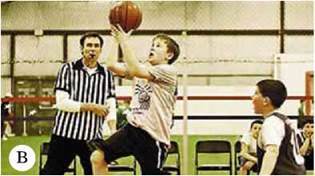
Oles - the 8th form - a lyceum - Algebra and Geometry - a school basketball team - to train for the competitions.
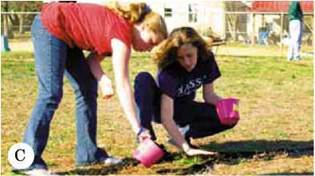
Schoolchildren - a gymnasium - social work - to work cooperatively - to make a difference - to develop life skills.
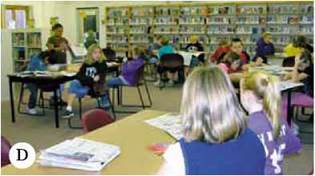
The pupils of a language school - the European Club - to have penfriends around the world - to write letters - to learn more about the life in other countries.
Example:
A: Where is Olena?
B: She’s in the Information Technology classroom. A: What is she doing there?
B: She is preparing a report on History.
A: Are there good facilities in her school? B: Yes, there are.
A: What type of school does she study at? B: She studies in a secondary school.
2. Speak in class. Say what type of school you study at. Tell your classmates about the activities you have in your school and participate in.
3. Read what the children say about the school they go to. What makes their education there so special?
Maksym Shcherbyna, 13: «I’m fond of Maths and Physics. I’m happy to get my education in the same lyceum where my two elder brothers went to. I think I’ve made excellent progress in my studies, and I hope I’ll be a good support in a family business in future.»

Natalia Sokolova, the sister of Alex and Liz, is the third Sokolova to join the City Humanitarian Gymnasium. In her first year in the gymnasium she got the highest marks in Ukrainian Language and Literature as well as in Maths and Physics.
«I am sure my family support and my brother’s and sister’s previous experience have made my studies so successful. I am proud to be a part of this gymnasium.»

Ihor Ivasiuk, 13: «It’s very important that we can choose schools for ourselves to go to. I study at a language school. I have usual subjects in my timetable. We have five English lessons a week. Besides we have some language clubs. I am a member of the Debate Club, for example. My parents and my elder sister studied in the same school. My English teacher taught my mother when she went to school. Can you believe that?»

4. Read and tick the statements M (Maksym), N (Natalia), I (Ihor).
____ 1. I am fond of Maths and Physics.
_____2. I had a very distinctive year, and my brother’s and sister’s previous experience was very helpful.
____ 3. I have five English lessons a week.
____ 4. I have made excellent progress in my studies.
____ 5. It’s very important that we can choose schools for ourselves to go to.
____ 6. I am proud to be a part of this gymnasium.
Learning Strategies: Listening Activities
1. Read the rubrics in the table carefully.
2. Think of the topics the speakers will mention.
3. Think of things you would like to know and write questions.
4. Listen carefully and see if you get all the answers to your questions.
5. Listen for the details and complete the table.
5. a) Listen to the children talking about the schools they go to - a secondary school and a gymnasium. Complete the table.
Questions |
A Secondary School |
A Gymnasium |
Location and size |
||
Facilities |
||
School subjects |
||
After-school activities |
b) Work in pairs. Compare your results. Ask questions to add information to your table.
6. Read and match the people who work at school (1-10) with the work they do (a-j).
1. Headmasters |
a) help the Headmaster run the school; |
2. Physical Education Teachers |
b) keep the Headmaster’s Office running; |
3. Social Workers |
c) check the books in the school library; |
4. Psychologists |
d) check records to make sure children are healthy; |
5. Art and Music Teachers |
e) plan how to teach English, Science, Maths and other school subjects; |
6. Librarians |
f) work with pupils, their parents and teachers to test and understand how to help children study better; |
7. Secretaries |
g) check the sports equipment; |
8. Teachers |
h) teach students to draw, sing, understand notes, play and sing from the music; |
9. School Nurses |
i) decorate the classrooms for the new school year; |
10. Vice Principals (Assistant Principals) |
j) get ready to greet the pupils and run the school during the year. |
7. Speak in class. Talk about the people who work at school. Use Ex. 5 on p. 40. Start like this:
All schools are different, but there are some people who are always ready to help the schoolchildren. They are ….. . Etc.
8. Put the verbs in brackets into the correct tense form.
1. - What are you doing now? - I ….. (to check) this computer.
2. - Who ….. (to work) with students, their parents and teachers to help children study better? - I think, school psychologists.
3. Our school nurse ….. (already / to check) all the important records.
4. The librarian ….. (to check) the books, when I ….. (to come) into the library.
5. Can I ….. (to talk) to your parents?
6. The new Headmaster…. (to run) our school this year.
Перша публікація: 01/01/2016
Останнє оновлення: 31/12/2023
Редакційна та навчальна адаптація: Даний матеріал зведено на основі першоджерела/оригінального тексту. Команда проєкту здійснила редакційне оглядове опрацювання, виправлення технічних неточностей, структурування розділів та адаптацію змісту до навчального формату.
Що було опрацьовано:
- усунення форматних дефектів (OCR-помилки, розриви структури, дефектні символи);
- редакційне упорядкування змісту;
- уніфікація термінів відповідно до академічних джерел;
- перевірка відповідності фактичних тверджень тексту першоджерела.
Усі згадки про автора, рік видання та походження первинного тексту збережено відповідно до джерела.