Підручник Англійська мова 7 клас (8-й рік навчання) - Алла Несвіт - Генеза 2016 рік
UNIT 2 School Life
In this unit you will…
Listen, read and talk about…
• school rules
• school subjects
• stages of education and schools in Ukraine
• different types of schools in Great Britain
Learn how to.
• ask and present information about school subjects and school rules
• understand information during a discussion
Practise/Revise…
• tense forms
• sentences with the conjunctions If… and Unless…
Write/Make…
• a letter to a newspaper
• a composition about school subjects
• an article to a school newspaper
Lessons 1-2. My Studies at School
1. Work in pairs. Discuss the questions.
1. What school do you study at?
2. Are there any school rules that you have to follow?
3. What do you like about going to school?
4. What don’t you like about going to school?
5. What would you like to change in your school (classroom)?
6. Is your school a nice place to study?
2. Read and say what Ann likes about going to school.
Dear Mary,
How are you? Are you happy to be back to school?
There are some things that I like about going to school.
Firstly, I like to meet my classmates. Many of them are very nice people. As soon as we come to the classroom, we discuss our problems, talk about life, future plans and other things.
Secondly, it is interesting to do the projects or the experiments during the lessons. My favourite subjects are Geography, History and English.
Thirdly, school helps me to get some social skills. I learn to be positive and flexible. I learn to share the attention of my teachers with the other pupils in class. I respect my teachers because all of them are intelligent, highly qualified, sympathetic and understanding.
However, there are some things that I don’t like about going to school. To start with, I have to get up very early as I don’t live close to my school. Also, we have to wear a school uniform. It’s boring! Finally, I always have to do my homework and don’t have much free time for my hobbies.
All in all, school life is fantastic. We not only enrich our knowledge about life, but learn how to get on with each other. We learn to combine work and leisure.
What do you think about going to school? Are there any rules you have to stick to in your school?
Write to me and tell me all your news.
Best wishes, Ann.

3. Read and tick the statements T (True) or F (False).
_______ 1. Ann likes both: all school subjects and people at school.
_______ 2. School helps the children get some social skills.
_______ 3. Ann learns to develop positive qualities in her character.
_______ 4. Ann likes all the school rules.
_______ 5. Ann doesn’t feel comfortable with her homework.
_______ 6. School is not only subjects - it is the school of life.
4. a) Fill in am, is / isn’t, are / aren’t, or do / don’t. Name the tenses of the verbs, then explain their usage.
b) Listen and check your answers.
A: Where ……… you from, Larysa?
B: I ….. from Kyiv.
A: ….. you enjoy it here, in Artek-Bukovel?
B: Definitely. Nature is really beautiful here. Besides, I have a chance to meet children from all over Ukraine in this youth camp.
A: Larysa, ….. you miss your school friends?
B: No, I ….. But I wish they were here. When I ….. back home, I’ll have lots of stories to tell them. I think that we enrich our knowledge about the surrounding world as well as practise our life skills.
A: ….. there any things that you ….. like about going to school?
B: Yes, there ….. I like everything: my friends, teachers, the school building and the activities we have.
A: Enjoy your time in Artek!
B: Thank you very much.
5. Read and complete the sentences with the word combinations from the list. Use the verbs in the correct tense form.
• to discuss something • to get good knowledge • to be understanding and sympathetic • to happen • to enrich somebody's knowledge • to get on well • to cope with something • to combine work and leisure •
1. She ….. during the day. To my mind, she has learnt to plan her working day perfectly.
2. Steve has joined the Chemistry Club. in this school subject.
3. Whatever ….. . don’t forget to ring Mark.
4. They ….. a story when the school bell rang.
5. There was too much work for our computer.
6. My youngest brother ….. with all his classmates.
7. My elder brother is rather successful in business. I think he ….. when he was at school and at the university.
8. My friends ….. They are easy to be with and always keep our secrets.
Writing Lab: Linking Words and Phrases
Linking words show the logical relations between sentences or parts of a sentence.
We use linking words and phrases in a composition to make our writing more interesting and easier to understand to the reader.
Linking words and phrases are used to:
• show time: when, before, as soon as;
• list points: firstly, secondly, etc.;
• add more points: and, moreover, also, etc.;
• show cause or effect: because, so, as a result, etc.;
• give examples: for example, such as, etc.;
• show contrast: however, on the one hand, on the other hand, etc.;
• show purpose: to, so that, in other (not) to, etc.;
• describe the conditions: if, whether, unless, only if, etc.;
• introduce a conclusion: all in all, to sum up, etc. 6
6. Look through the text of Ex. 2 on p. 34. Find linking words and phrases and say why they are used there.
Example:
The linking word ’firstly’ is used to list a point.
7. Work in groups. Discuss the things that you like / don’t like about going to school. Take notes. Think of:
• school rules;
• school traditions;
• clothes to wear;
• people;
• a school building.
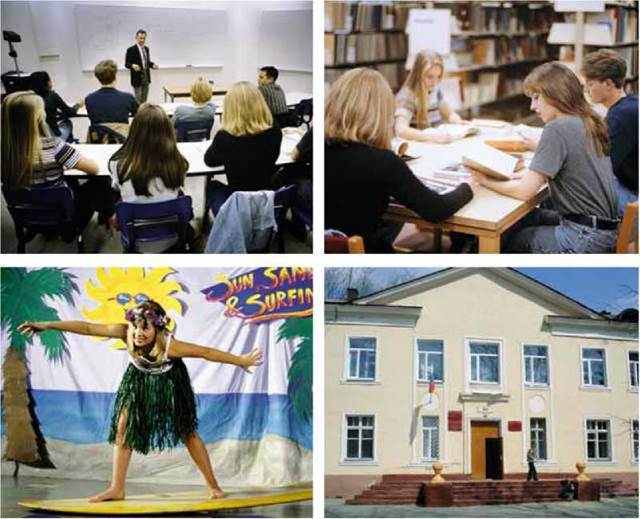
8. Speak in class. Talk about your school rules, traditions and studies.
• What things make your school life exciting?
• What’s more important to you: school lessons or extra-curricular activities? Why?
• Do you think the general public in the school neighbourhood should be informed about the ongoing school events and projects?
9. Write a short story to your school newspaper about the things you like / don’t like about going to school. Use the linking words to list your points of view. What are the things you would like to change in your school life?
Перша публікація: 01/01/2016
Останнє оновлення: 31/12/2023
Редакційна та навчальна адаптація: Даний матеріал зведено на основі першоджерела/оригінального тексту. Команда проєкту здійснила редакційне оглядове опрацювання, виправлення технічних неточностей, структурування розділів та адаптацію змісту до навчального формату.
Що було опрацьовано:
- усунення форматних дефектів (OCR-помилки, розриви структури, дефектні символи);
- редакційне упорядкування змісту;
- уніфікація термінів відповідно до академічних джерел;
- перевірка відповідності фактичних тверджень тексту першоджерела.
Усі згадки про автора, рік видання та походження первинного тексту збережено відповідно до джерела.