Підручник Англійська мова 5 клас для спеціалізованих шкіл з поглибленним вивченням англійської мови - Л.В. Калініна - Генеза 2018 рік
Unit Five: School Life
5:3. What are your leisure activities in between the lessons?
Word Bank |
Phrase Bank |
Communication Box |
illustrator |
to design a web page |
As usual … |
project-maker |
to win the first prize |
Thank goodness! |
scanner |
to be good at sth |
How about …? |
to do puzzles |
to print something out |
It sounds like … |
theme park |
in colour (not) to waste time |
I bet … |
I. Conversation Warm-up
Mime what you normally do after classes. Let your classmates guess and say if they do the same.
II. Pronunciation Warm-up
Listen to/read the computer fun rhyme and practise the sounds /u:/ and /ʌ/. Say what you think of the boy’s after-school activity.
THE COMPUTER FUN RHYME
Little Roy Scooter
has bought a computer.
Give him another
to match the other
and he will play on two.
III. Grammar Smart
1. Look and recall!
SOME |
ANY |
I can take some pictures for the project. |
Can you take any pictures for the project? |
2. Play a grammar agreement game.
Example: A: Can you print out any pictures in colour?
B: Sure I can print out some.
to create |
to draw funny |
to take part in |
to post |
web pages |
pictures |
competitions |
comments |
Для того, щоб правильно розповідати про когось, вживай займенники someone / somebody, anyone / anybody, no one / nobody.
Example: Someone / somebody is at the door.
Has anyone / anybody won the first prize?
No one / nobody must waste time.
Для того, щоб правильно розповідати про щось, вживай займенники something / anything / nothing.
Example: I have something to tell you.
Have you got anything to say?
Nothing happened yesterday.
a) Choose the right word.
Example: I don’t have … (some / any ) plans for the afternoon. →
I don’t have any plans for the afternoon.
1. We will do … (some / any) after classes.
2. Helen can draw … (some/ any) funny pictures.
3. Steve has never taken part in … (some /any) competitions.
4. … (Anyone / no one) won the first prize.
5. Everyone has … (something / nothing) to do for the project.
b) Complete Steve’s e-mail with pronouns.
Dear friends,
I haven’t heard from you for some time. I hope … wrong has happened, you are just too busy. I have … to tell you: I am going to do … travelling soon. I am going to come to Ukraine and stay for … days there. Perhaps we will do … special together.
Have you got … travelling plans? Write to me soon.
Steve
IV. Word Smart
Things and plans for after-classes activities |
After-classes activities |
• music |
• doing sports (swimming, |
• cartoons |
running, jogging) |
• outings |
• playing sports games: |
• web page |
football, basketball |
• TV and video
• theatre
• cinema
• school clubs
• theme parks
• playing computer games
• making projects
• creating something new
• spending time out in the open
• doing puzzles
1. Study these words and phrases and describe:
• what different things you and your friends can do after classes;
Example: My friends and I can choose between an outing and a school club.
• what you did after classes last week.
Example: As it rained a lot last week, I stayed at home and did puzzles.
2. Read the notices, choose a leisure after school activity for you and say why you’ve chosen it.

Example: I think I will join the ecological club, because I love nature and want to be environmentally friendly.
3. Interview your classmates and ask:
• What they like to do after classes?
• Where they like to spend their free time after classes?
• Whom they share their after-school activities with?
Present your findings to the class.
Example: I’ve found out that Nina likes to do swimming after classes. She goes to the swimming pool three times a week. Her friends Nelly and Ann share Nina’s interests.
At Home:
Keep a record of all the after-school activities in which you are taking part this week and rank them in order of importance. Describe one of them.
Go to Ex. 91-92 of your Workbook
V. Time to Read
1. Read in trios and choose the best title for the children’s project.
Give reasons for your choice.
1. Spending Time Together
2. Unforgettable Impressions
3. Enjoying Nature!
Ann: I say, Helen, are you going to join me in the swimming pool after classes? We can do a lot of swimming, as usual.
Helen: Not today, I’m afraid. I must get ready for my music lesson. I have them 3 times a week, you know.
Steve: Thank Goodness, I’ve found you, girls. I have something to tell you.
Ann: I hope it is not about football again. You seem to be crazy about it.
Steve: Poor guess! How about taking part in a project competition? We can design a web page about our favourite outings.
Helen: It sounds like a lot of fun.
Ann: I bet, you like this idea, Steve, right?
Steve: Sure. It’s interesting to create something new and to show what we can do, don’t you think?
Helen: I do. How do you like the idea of creating a web page about our favourite pastime out in the open?
Ann: Sounds good.
Helen: I know, Ann, that you can take good pictures. Last year your photo «Rafting in Wales» won the first prize at our school competition.
Ann: Glad you remember it. I can be a photographer and take some nice pictures for our project.
Steve: Since Helen is very good at drawing, she can draw some funny pictures.
Helen: I don’t mind being an illustrator, but I think cartoons are much better for this. And you, Alex, have a good head for information and computer technologies. Can you design our web page on the computer?
Steve: I’ll try. I know how to use the scanner and do the design.
Ann: Great! Our ICT teacher can help to print out the whole page in colour.
Helen: It is going to be a nice project, I believe. Steve is a good designer and we are good project makers.
Ann: We mustn’t waste time. Let’s get started.
ICT
See First Aid Kit:
Word Building 5, p. 237
Across Cultures
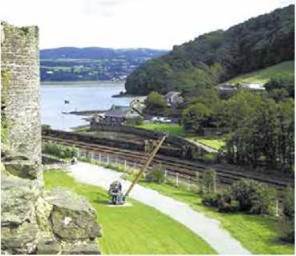
Wales - частина Великої Британії
2. In the text «Talking in between the Classes», find the nouns formed from these verbs and translate the sentences with them.
Example: to write → writer
1. to design → 3. to illustrate →
2. to photograph → 4. to make (a project) →
3. Complete the sentences as in the text.
Example: It is interesting to create something new.
1. Since Helen is very good … .
2. She likes … much better than … .
3. Steve has a good head for ….
4. He can … .
5. The children’s ICT teacher can … .
6. It’s going to be … .
VI. Time to Communicate:
1. Act as Ann and describe your plans for the time after classes.
to join smb
to do a project
to win the first prize
to take pictures
to print sth out in colour
2. Act as Steve and describe the way you are going to do your project.

to design a web page
to take part in sth
to be good at sth
to use the scanner (not)
to waste time
3. In pairs, discuss your after-school activities. Use the pattern.
Pattern:
- I bet … right.
- Sure. It’s interesting …. How do you like …?
- It sounds …. I know … and you can ….
- Exactly! Since you are good at … What about?
- I don’t mind … … has a good head for … and … .
- Great! It’s going to be … .
- We mustn’t …. Let’s … .
- Sure. … . I believe … .
VIII. Time to Write
Write a short essay about your after-school activities. Cover the following questions:
• What activities are the most popular with fifth-grades?
• What are your favourite activities?
• How often do you take part in them?
• Who do you like to share your activities with?
Go to Ex. 93-95 of your Workbook
Перша публікація: 01/01/2018
Останнє оновлення: 31/12/2023
Редакційна та навчальна адаптація: Даний матеріал зведено на основі першоджерела/оригінального тексту. Команда проєкту здійснила редакційне оглядове опрацювання, виправлення технічних неточностей, структурування розділів та адаптацію змісту до навчального формату.
Що було опрацьовано:
- усунення форматних дефектів (OCR-помилки, розриви структури, дефектні символи);
- редакційне упорядкування змісту;
- уніфікація термінів відповідно до академічних джерел;
- перевірка відповідності фактичних тверджень тексту першоджерела.
Усі згадки про автора, рік видання та походження первинного тексту збережено відповідно до джерела.