Підручник Англійська мова 4 клас - Несвіт Алла - Генеза 2015 рік
Unit 3 FREE TIME
Lesson 1
1. a) Listen and repeat.
like + -ing
enjoy + -ing

b) Listen and read.
A hobby is a thing you like doing in your free time. Different people have different interests or hobbies. Many people collect something - coins, stamps, CDs, toys or books. Your life becomes interesting if you have a hobby. Some children enjoy singing, dancing or playing the musical instrument. Girls usually like painting and making things. Boys like playing sports.
2. Answer the questions.
1. What is a hobby?
2. What do people collect?
3. What do girls usually like doing?
4. What do boys like doing?
3. a) Work in pairs. Take turns to ask your friend about his/her hobbies and take some notes.
E x a m p l e: - Do you play any sports?
- Yes, I do. / No, I don’t.
Do you…
… play any sports?
… cook?
… collect anything?
… read a lot?
… listen to music?
… play the piano?
Have you got any other hobbies?

b) Tell the class one or two things about your friend’s hobby.
E x a m p l e: Olena has got a hobby. She collects dolls. She also plays the piano.
4. a) Look and say what you like doing.
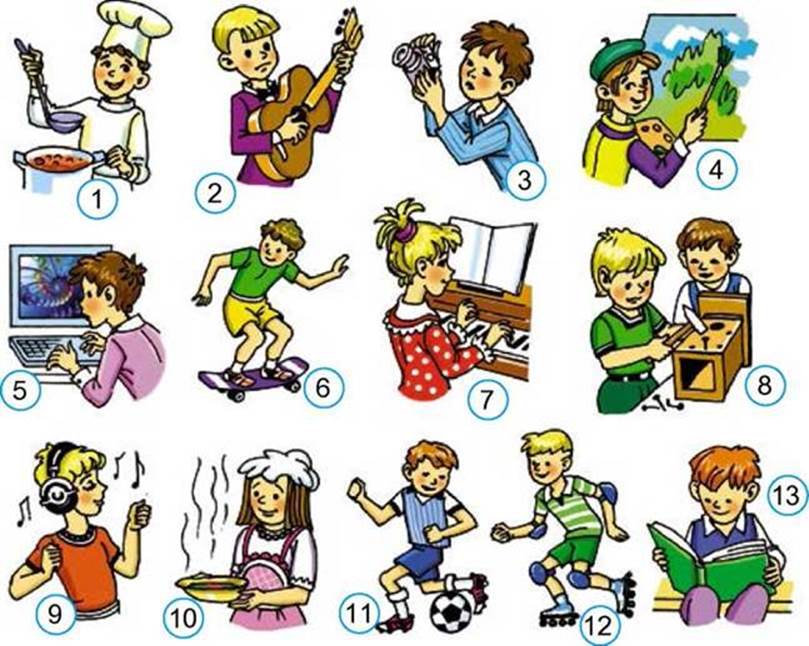
E x a m p l e: I like singing and dancing.
b) Talk about each hobby you see in Ex. 4a).
E x a m p l e: I think ….. is interesting (boring, easy, difficult, exciting).
5. Write six sentences about your hobbies.
E x a m p l e: My name is Alex. I am nine. I have a hobby.
I collect toy cars. I think it is interesting. And I also like riding a bike and playing football.
Перша публікація: 01/01/2015
Останнє оновлення: 31/12/2023
Редакційна та навчальна адаптація: Даний матеріал зведено на основі першоджерела/оригінального тексту. Команда проєкту здійснила редакційне оглядове опрацювання, виправлення технічних неточностей, структурування розділів та адаптацію змісту до навчального формату.
Що було опрацьовано:
- усунення форматних дефектів (OCR-помилки, розриви структури, дефектні символи);
- редакційне упорядкування змісту;
- уніфікація термінів відповідно до академічних джерел;
- перевірка відповідності фактичних тверджень тексту першоджерела.
Усі згадки про автора, рік видання та походження первинного тексту збережено відповідно до джерела.