Підручник Англійська мова 9 клас (9-й рік навчання) - О. C. Любченко - Основа 2017 рік
UNIT 7 Fit in Britain
Lesson 7 VIEW OF A STEW
1. Write as many words as possible in one minute using the letters of the words «Home reading». Letters may repeat in different words. Don’t forget to share your ideas with your classmates.
Example: Home reading - home, read, reading, red, ring, … (your variants)
2. Read the passage from Jerome K. Jerome’s story «Three men in a boat» and answer the questions. Don't try to answer any questions without looking carefully at the text.
How We Cooked an Irish Stew
(adapted from Jerome K. Jerome )
George said that, as we had plenty of time, it would be a splendid opportunity to try a good supper. He said he would show us what could be done up the river in the way of cooking, and suggested that, with general odds and ends, we should make an Irish stew.
It seemed a fascinating idea. George made a fire, and Harris and I started to peel the potatoes. I had never thought that peeling potatoes was such an affair. The job turned out to be the biggest thing of its kind that I had ever been in. We began cheerfully, but our light-heartedness was gone by the time the first potato was finished. The more we peeled, the more peel there seemed to be left on; by the time we had got all the peel off, there was no potato left—at least none worth speaking of. George came and had a look at it—it was about the size of a pea-nut. He said:
«Oh, that won’t do! You must scrape them.»
So we scraped them, and that was harder work than peeling. We worked for five-and-twenty minutes, and did four potatoes. Then we said the rest of the evening would go for scraping ourselves.
It seemed difficult to believe that the potato-scrapings in which Harris and I stood, could have come off four potatoes.
George said it was absurd to have only four potatoes in an Irish stew, so we washed half-a-dozen or so, and put them in without peeling. We also put in a cabbage and peas. George stirred it all up, and then he said that there seemed to be a lot of room to spare, so we picked out all the odds and ends and added them to the stew. There were half a pork pie and some cold bacon left, and we put them in. Then George found half a tin of salmon and emptied that into the pot.
He said that was the advantage of Irish stew: you got rid of such a lot of things. I fished out a couple of cracked eggs and put those in. George said they would thicken the gravy.

I forget the other ingredients, but I know nothing was wasted; and I remember that, Montmorency, who had showed great interest in the process, went away with a thoughtful look, and in a few minutes came back with a dead water-rat in his mouth, to present it as his contribution to the dinner.
We had a discussion about whether the rat should go in or not. Harris said it would be all right, mixed up with the other things, but George said he had never heard of water-rats in Irish stew, and he would rather be on the safe side, and not try experiments.
It was a great success, that Irish stew. I don’t think I ever enjoyed a meal more. There was something so fresh about it: a dish with a new flavour, with a taste like nothing else on earth.
George said there was good stuff in it. The peas and potatoes might have been a bit softer, but we all had good teeth, and as for the gravy, it was a poem.
3. Find the words and phrases in bold in the text above and replace them with the option closest in meaning (A, B or C). Don't waste too much time on a difficult word. Move on!
A |
B |
C |
|
1. odds and ends |
leftovers |
trash |
junk food |
2. light-heartedness |
optimism |
comfort |
sadness |
3. stirred … up |
blew up |
brought up |
mixed up |
4. room to spare |
free room |
free space |
free sit |
5. got rid of |
got on with |
gave away |
threw away |
6. thicken |
condense |
melt |
fry |
7. be on the safe side |
take a chance |
avoid risk |
be in danger |
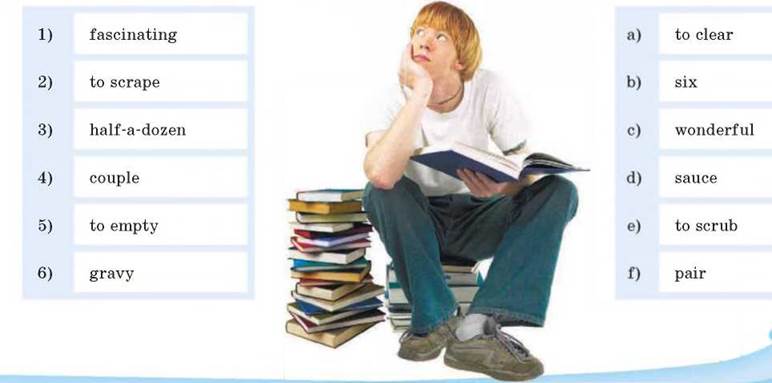
4. Match the synonyms to the rest of the words in bold. Make up your own sentences with them.
5. Answer the questions without looking back in the story.
1) Tell why the title is a good title for this book.
2) What is the problem in this story and how is it solved? Use a detail from the story to explain your answer.
3) How many characters are there in the story?
4) How do the characters feel in the beginning? How do these feelings change throughout the story?
5) How do the characters feel at the end of the story?
6) Who is telling the story? How do you know?
Did you know?
There is a debate about whether or not wolves should be returned to Scotland to reduce the red deer population.
6. Read the statements below and decide if they are True or False. Mark them with T or F. Explain your choice.
1) George wanted to cook an Irish stew because his friends and he were gourmands.
2) Harris and the author could peel vegetables well.
3) There were all odds and ends in the stew: some potatoes, cabbage, peas, a pork pie, bacon, tinned salmon and two eggs.
4) The author fished in the river before cooking.
5) When Montmorency brought a dead waterrat, the friends decided to avoid a risk and didn’t put it into a stew.
6) They needed raw pork and fish to cook an Irish stew.
7) The author forgot the rest of the ingredients.
8) That was the best meal they had ever eaten.
7. Work in groups of three. Retell what happened in the story if you were George, Harris and the author. Present your work to your classmates.
8. Make sure you understood the story. Create an alternative ending to it. Use the idioms and phrasal verbs of the unit.
9. Choose one of the characters and describe him: show his traits of character, his attitude to problems; write why you chose this one; what you would do in the same situation.

Перша публікація: 01/01/2017
Останнє оновлення: 31/12/2023
Редакційна та навчальна адаптація: Даний матеріал зведено на основі першоджерела/оригінального тексту. Команда проєкту здійснила редакційне оглядове опрацювання, виправлення технічних неточностей, структурування розділів та адаптацію змісту до навчального формату.
Що було опрацьовано:
- усунення форматних дефектів (OCR-помилки, розриви структури, дефектні символи);
- редакційне упорядкування змісту;
- уніфікація термінів відповідно до академічних джерел;
- перевірка відповідності фактичних тверджень тексту першоджерела.
Усі згадки про автора, рік видання та походження первинного тексту збережено відповідно до джерела.