Підручник Англійська мова 9 клас (9-й рік навчання) - О. C. Любченко - Основа 2017 рік
UNIT 5 Reliance on Science
Lesson 4 GALLANT TALENT
1. In groups, make up a cinquain on the word «discovery». Compare the results in class and choose the best one. (To revise the rules of making cinquains see Unit 1, Lesson 1.)
2. Look at the sentences below. They show us predictions, offers, facts, decisions, suggestions etc. What words help us to express these meanings?
1) You will take my dictionary if you need. (You may take my dictionary.)
2) It's hot in here. Shall we open the window? (I propose you to open the window.)
3) He will be talking all the time without doing anything. (He usually talks much.)
4) I think John will fly to Paris with his girlfriend next month. (They have decided.)
5) She will buy a new outfit for the party. (She has decided to buy a new outfit for the party.)
6) This airplane will take 200 passengers. (We know the fact about this airplane)
7) It looks like it will rain tonight. (The prediction is that it rains tonight.)
3. Look through the Quick Grammar Aid ’WILL / SHALL’ part and do the exercise. Fill in the gaps with will / shall and explain your choice. Share your results.
1) The news spread soon.
2) He take this duty.
3) This kettle hold two gallons of water.
4) Let’s have a snack, we?
5) you stop talking like that?
6) The doctor call you in the morning.
7) we have lunch together?
4. Compare the following pairs of sentences. Can you identify the difference in form and meaning? How can you tell? Look through the Quick Grammar Aid ’SHOULD / SHOULDN’T’ part if necessary to answer the questions.
1) I think you should study for the test so that you don't fail. - I should have studied more but I was too tired.
2) You shouldn't talk like that to your grandmother. - You shouldn’t have been rude to him. He’s going to be really angry now.
Did you know?
The first programmable computer was invented by the British mathematician and scientist Charles Babbage in the 1820s.
5. Complete the sentences and write them down into two columns. Which of the modals do you have to use: should / shouldn’t + V or should have/ shouldn’t have + V3? Check your results in class.
1) 1… (start) saving money years ago!
2) Does your tooth still hurt? You … (make) an appointment with the dentist.
3) You … (pay) more attention in class.
4) You … (take) this job. I can see you’re not enjoying it.
5) I’m really cold! I… (bring) my coat.
6) Your hair is too long. You … (get) a haircut.
7) It… (be) fine tomorrow.
Advice / negative advice |
Past advice / past negative advice or Regret |
Quick Grammar Aid - Modals
1. We use WILL / SHALL as modals to make predictions and state facts about the future: |
There will be strong winds tomorrow in the south of the country. We’ll meet you outside the coffee shop. |
2. We use WILL / SHALL to announce decisions and to make offers: |
Which size do you want? Medium or large? - I’ll have large. (decision ) Wait. He will open the door for you. (offer) |
3. When we use SHALL I and SHALL WE in questions it is usually to make suggestions: |
It’s getting late. Shall we go home? |
1. SHOULD HAVE + past participle can mean something that would have been a good idea, but that you didn't do it. |
I should have studied harder! (= I didn't study very hard and so I failed the exam. I'm sorry about this now). |
2. SHOULDN'T HAVE + past participle means that something wasn't a good idea, but you did it anyway. |
I shouldn't have eaten so much cake! (= I did eat a lot of cake and now I don't feel good.) |
3. We can also use this to talk about something that would have happened if everything was fine in the past, but hasn't happened. |
Lucy should have arrived by now, but she hasn't. |

6. In groups of 3, think about a short list (3-4 names) of people who in your opinion have made the greatest contribution to the modern world in the field of science and technology. Share your names in class. Why those people?
7. What do you know about the person in the picture? What is he famous for?
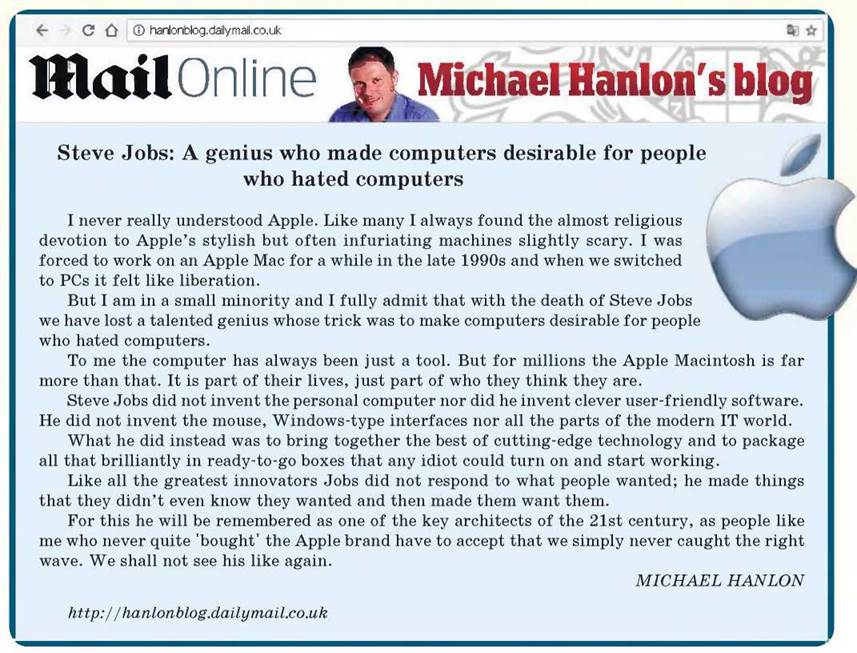
8. Read a blog extract about Steve Jobs and find out if the author’s opinion about the importance of Jobs is the same as yours.
9. Find information about another computer genius - Bill Gates and compare him to Steve Jobs.
10. Complete the sentences with will / shall, should / shouldn’t or should have / shouldn’t have. Use the Grammar Reference if necessary.
1) We (invite) so many people to our party! I’m worried that we won’t have enough room for everyone.
2) I posted the cheque yesterday so it_______ (arrive) this week.
3) I (do) it as you say.
4) You _____________ (be) at work before 9.
5) (go) now?
6) You _____________ (buy) some milk at the shops. We don’t have any milk.
7) You really_____________ (go) to the new restaurant on Main Street.
8) I (mow) the lawn tomorrow.
9) Our neighbours___________ (cut) down the tree in their garden. It was a really beautiful tree.
10) Are you tired? You___________ (work) so much.
Перша публікація: 01/01/2017
Останнє оновлення: 31/12/2023
Редакційна та навчальна адаптація: Даний матеріал зведено на основі першоджерела/оригінального тексту. Команда проєкту здійснила редакційне оглядове опрацювання, виправлення технічних неточностей, структурування розділів та адаптацію змісту до навчального формату.
Що було опрацьовано:
- усунення форматних дефектів (OCR-помилки, розриви структури, дефектні символи);
- редакційне упорядкування змісту;
- уніфікація термінів відповідно до академічних джерел;
- перевірка відповідності фактичних тверджень тексту першоджерела.
Усі згадки про автора, рік видання та походження первинного тексту збережено відповідно до джерела.