Підручник Англійська мова 9 клас для спеціалізованих шкіл з поглибленим вивченням англійської мови - Л.В. Калініна - Генеза 2017 рік
Unit 4 Science and technology
4.1. Science vs Technology
Word Bank |
Phrase Bank |
Communication Box |
✵ to function; ✵ practitioner; ✵ to govern; ✵ to elucidate; ✵ to imply; ✵ to employ; ✵ to verify; ✵ to assess. |
✵ cordless phones; ✵ to be interrelated; ✵ to result in; ✵ steam engine; ✵ to increase the human life span; ✵ to raise standards of living; ✵ in theory/practice. |
✵ I believe that… ✵ Talking of… ✵ From my point of view. ✵ I must admit that… |
I. Go Ahead!
Look at the photos and say how the things in them contributed to the further development of modern science and technology.

First telephone
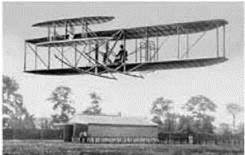
First plane

First book

Archeological artefacts

Example: I think with the invention of the telephone people got an opportunity to communicate at a distance. With time the first telephones were replaced by cordless phones and then by cell phones. Today we can’t imagine our life without them.
ІІ. Reading
Read opinions of different people on science and technology and say what differences and similarities they have.
As a physicist, I believe that science studies the physical world, because scientists like asking ’why’ and ’what’ questions. ’What’ questions are easy to answer, but ’why’ questions are much more difficult as they require explanation. Technology, I think, often asks ’how’ questions and answers them, therefore we can define technology as the use of science for practical purposes. Besides, technology may be methods and machines that are used in doing things in a science or profession.

David Grave, a physicist
* * *
In my opinion, science and technology are interrelated. Some technologies cannot function without science. Moreover, there are many modern technologies that started developing from old technologies without any help of science. The varying interplay of the two can be observed in the historical development of such practitioners as chemists, engineers, physicists, astronomers, carpenters. History knows a lot of facts when people made things and after that science tried to explain them. Suffice it to say, that fundamental processes in the fields of mechanics, biology, chemistry, astronomy, metallurgy were developed before the laws governing their functions were discovered. For example, a steam engine was widely used before the science of thermodynamics physical principles of its operations were elucidated. During certain periods of history innovations in technology have grown so fast that they resulted in industrial revolution.

Liza O’Corn, a historian
* * *
Talking of industrial revolutions, I suggest looking back at Britain of the 18 th century. The industrial revolution - the period of time when machines were invented and factories began to appear - began in Britain and then spread to many European countries and North America. It brought a lot of changes into people’s lives. Nowadays, when we live in the age of well-developed sciences like genetic engineering, electronics, new information computer technologies and enjoy using many of them, why not think of a new industrial revolution?
Mark Shelton, a sociologist
From my point of view, science and technology have more similarities than differences. Both science and technology imply a thinking process, employ experimental methodology that results in demonstrations that can be verified by repetitions. In theory science is more concerned with the development of general laws, but in practice science and technology are closely connected. Assessing science and technology and their effect on society, I must admit increasing of the human life span, raising the standards of living to a point unimaginable only a century ago, appearing new branches of science like space medicine, space biology, developing modern management, teaching, farming techniques. Today you can hardly imagine your life without both of them.
Teresa Brown, a philosopher
III. Language Track

5. In the text, find and reproduce introductory phrases in context according to the pattern. Practise saying them in their own sentences.


1. Study the difference in meaning. Reproduce the words from the text in context. Make up your own sentences by analogy.
technology - new machines, equipment and way of doing things that are based on modern knowledge about science. |
technique - a special way of doing something. |
Example: New communication technologies have transformed the business world. |
Example: There are various techniques for dealing with industrial pollution. |
2. From the text, reproduce the following words and phrases in context and interpret their meanings.
✵ practitioner |
✵ to imply |
✵ interplay |
✵ to result in |
✵ fundamental process |
✵ in theory |
✵ to govern |
✵ to assess |
✵ industrial revolution |
✵ unimaginable |
3. Match the sciences mentioned in the text and technologies. In each pair which do you think appear first - the science or the technology?
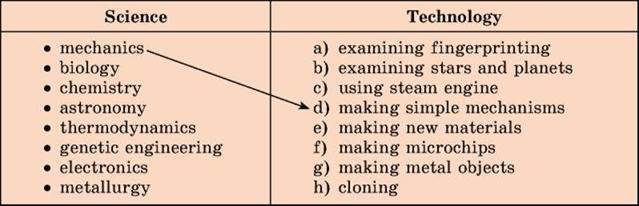
Example: I think the technology of making simple mechanisms appeared before mechanics formulated its laws.

1. From the text reproduce '-ing' forms in bold and define their functions.
2. Complete the instruction and illustrate it with your own examples.
✵ If you want to state a fact focusing on its subject, object or complementing function, use the gerund-base form verb + -ing' which follow… .

3. Look at the photos and say what pupils in them enjoy, like, practise, finish, keep doing.

Example: I think pupils like experimenting. They enjoy making experiments with different reagents

IV. Communication Track
Speaking
a) Express your ideas on the development of science and technology in the 21 -st century. Use the star technique.

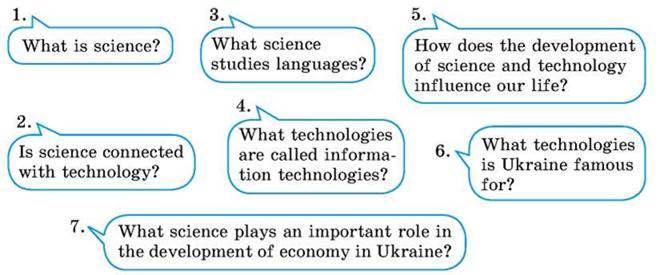
b) In pairs, read the pupils’ questions in science class and try to discuss possible answers to them in your dialogues.
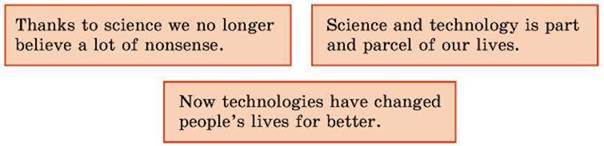
3. In the whole group, comment on the statements about science.
Listening
a) Before you listen
You are going to listen to the information of British anthropologist under the title «The Ecology of Language». In groups try to predict the answer to the scientist’s question: «What makes West Africa one of the most linguistically diverse places in the world»?
b) While you listen
Listen to the information and match the numbers to the corresponding facts.
✵ 700 |
a) the years of Daniel Nettle’s linguistic research; |
✵ 12 |
b) distant languages in West Africa; |
✵ 4 |
c) months of rain in the North; |
✵ 11 |
d) months of the rainfalls in northern Nigeria and Ghana; |
✵ 4 |
e) languages of tiny Togo; |
✵ 20 |
f) months of a rainy season in the South; |
✵ 500 |
g) the number of languages in Cameroon; |
✵ 1 |
h) population of a small village Horom; |
✵ 6 |
i) a common language in northern Nigeria; |
✵ 275 |
j) the population of Cameroon. |
c) After you listen
In groups comment on Daniel Nettle’s research and say what, in your opinion, can influence the diversity of languages.
Writing
a) Before you write
If you want to give a brief restatement of the main points of information (an article, a book) without giving details write a summary.
✵ Brainstorm with your friends what important facts about science and technology young researches should bear in mind.
✵ Make a list of words and phrases you’ll use while writing a summary so as to sound convincing.
b) While you write
How to write a Summary of Information
Content Tips |
Language Tips |
✵ Briefly tell what the information is about. ✵ Keep your description short. ✵ Finish with a concluding thought of the information as a whole, but don’t include your own opinion. |
✵ The major topic is… ✵ The unique thing about… ✵ …have similarities and differences. ✵ Throughout history… ✵ The most important thing about. ✵ To summarize the ideas… ✵ There is no question that… |

At Home: In your WB, write a summary of any scientific information (technologies) you are interested in).
Перша публікація: 01/01/2017
Останнє оновлення: 31/12/2023
Редакційна та навчальна адаптація: Даний матеріал зведено на основі першоджерела/оригінального тексту. Команда проєкту здійснила редакційне оглядове опрацювання, виправлення технічних неточностей, структурування розділів та адаптацію змісту до навчального формату.
Що було опрацьовано:
- усунення форматних дефектів (OCR-помилки, розриви структури, дефектні символи);
- редакційне упорядкування змісту;
- уніфікація термінів відповідно до академічних джерел;
- перевірка відповідності фактичних тверджень тексту першоджерела.
Усі згадки про автора, рік видання та походження первинного тексту збережено відповідно до джерела.