Підручник Англійська мова 8 клас - Калініна Л.В. - Генеза 2016 рік
Unit One: My Friends and Me
1.4. Being Together
Word Bank |
Phrase Bank |
• latecomers • to admit • stuntman |
• to take up a hobby • to feel safe and sound • to join the fun • to participate in singing karaoke • talent contest • a stand-up comedian • leisure time |
Communication Box:
How to express preferences spending time together
• Are you planning on …?
• Does … appeal to you?
• Does …work well for you?
• Won’t you feel depressed knowing you … can’t make it?
• Is … on your list of likes?
• Do you mean you are a great lover of …?
• What’s your preference … or …?
• Would you like to …?
• I’m just here…
• Well, sure, maybe a little bit
• I think it’s pretty extreme …
• I really feel like …
• I refuse to believe that …
• Well, frankly speaking, I feel (no) enthusiasm for …
I. Now for it!
Read the advertisements and say which of them you’ll choose for your friends and yourself and why.
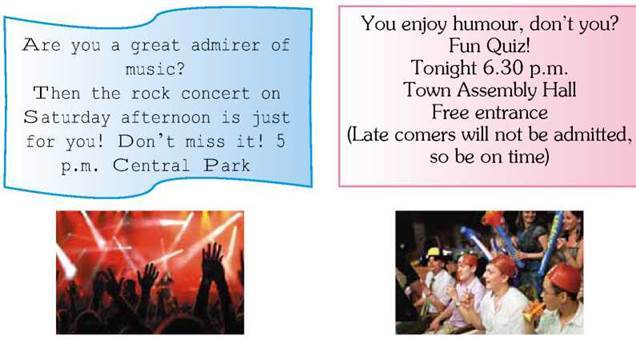

Example: As my friends and I are keen on music, we’ll go to the concert. I think we’ll enjoy it.
II. Reading
Read the dialogue between two friends and from the pictures suggested choose those the friends talked about.

Planning your Leisure Time
Helen: Hello!
Peter: Hello, Peter speaking.
Helen: Hi, …? I didn’t catch the name.
Peter: This is Peter Glibko.
Helen: Oh, Peter. Sorry, it’s not a very good line.
Peter: I wonder if you have anything special to do on Sunday. Are you planning anything special this week?
Helen: No, why?
Peter: Does the auto show appeal to you? I know you are interested in cars, unlike many other girls. Our classmates saw the show last Sunday and recommended us going there. I’ve got two tickets.
Helen: Well, I’ve never seen anything of the sort. I think it’s pretty extreme. Do you think there will be a car race? They say, it’s terrific.
Peter: No, it’s not like a car race. It’s when stuntmen drive cars and do different dangerous tricks, like driving through a hoop or driving on the wheel. I refuse to believe that you won’t like it.
Helen: Oh, I’m thrilled at the prospect. Stuntmen are courageous people. They perform breathtaking tricks. I’m absolutely sure I’d like to see it. So, I’m eager to join you. Do you know when it is going to start?
Peter: At 12 o’clock. We will have much fun together.
Helen: Speaking about fun, do you feel like going to our central park after the car race?
Peter: … to see the Karaoke competition? Some girls from our class were going to participate in it. I think it promises a great time, too.
Helen: Do you mean you are a great lover of Karaoke singing?
Peter: Not me. My cousin Oksana took up that hobby. She won the talent contest last year. She hopes to win and I’d like to support her.
Helen: I know Oksana. She is the best stand-up comedian in our school. But I never heard her singing. Can you tell me what songs she likes?
Peter: Wait a little and you’ll see for yourself. I’m sure it’ll be a fascinating show.
Helen: OK.
III. Language Track

1. From the dialogue, reproduce the general questions in context with a correct intonation. Follow the pattern.
Pattern:

1. Study the difference in meaning. From the text, reproduce the words in context and interpret their meanings. Make up your sentences by analogy.
contest - a competition, usually in which a judge or a group of judges, or the public decide the winner. Example: My pen-friend from Britain participated in a beauty contest last spring. |
competition - an organized event in which people or teams compete against each other. Example: My friends and I take part in sport competitions. |
2. Match words and phrases to their definitions. Find them in the dialogue and reproduce in their contexts. Give your examples with them.

Example: I appreciate the work of stuntmen. They are the most courageous people I know.
3. From the text, reproduce words/phrases the friends use to characterize a car race and karaoke singing. Use them to describe your hobby or favourite activity.
Example: terrific - they say, it’s terrific!
I personally like the circus and gymnastics. Tricks are terrific there for me.
1. From the dialogue, reproduce the grammar constructions in bold and interpret their meanings.
2. Complete the instructions.
• If you want to ask for more information, use…
• If you begin a question with: Do you know when… Could you tell me when…, the word order.
• If there is no question word (what/why etc.), use…

3. In chain, ask each other questions for more information about your leisure time.
Example: A: Can you tell me when the football match between our class and grade 9 begins?
B: I wonder if you take part in this match?
C: Do you know who the referee of the match will be?

IV. Communication Track
1. Speaking
1. Tell your classmates how you prefer to spend your leisure time with your friends. Use the guiding questions.
• How often do you spend your leisure time together?
• What does the choice of this activity depend on?
• How do you plan your leisure time?
• What activities are your favourite?
• Why do you like being together with your friends?
2. Read and learn how to express preferences on being together. Make up a dialogue round one of the mini-dialogues.
1) - Does___________ appeal to you?
- Well, frankly speaking, I feel no enthusiasm for it. I’d rather stay at home and watch TV.

disco
2) — Is ______ on your list of likes?
- Well, maybe a little bit, but not too often.
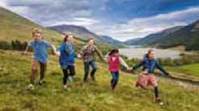
an outing
3) - I refuse to believe that you don’t like ____________.
- I think it’s pretty extreme and I like swimming better.
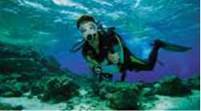
scuba diving
4) - Do you mean you are a great lover of _____________?
- I love it. I never miss a chance of seeing a football match.
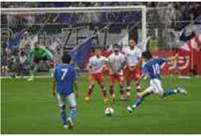
football
5) -What is your preference:_________ or theatre?
- I really feel like going to the circus. It’s ages since I’ve been there.
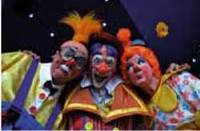
circus
6) - Would you like to see_______ ?
- By all means! I am thrilled at the prospect.
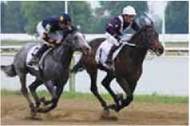
horse racing
3. In the whole class debate over the great man’s words:
Everyone is dragged by their favourite pleasure (Virgil)
2. Listening
a) Before you listen
You are going to listen to some teenagers talking about their leisure time with friends. In groups think and decide:
• What their favourite leisure activity may be;
• What they feel about being together.
b) While you listen
Listen to teenagers and fill in the chart.
Name |
Favourite activities |
Reason |
|
c) After you listen
In the whole class think and decide if being together has advantages and disadvantages. Could there be any possible minuses? Under what circumstances?
3. Writing
a) Before you write
• If you want to tell somebody about the most interesting thing which happened to you and your friends during your leisure time write a story.
• Brainstorm with your friends and decide on the episode you’d like to write about.
• Make a list of words/phrases you’ll use to make it interesting and exciting.
b) While you write
Content Tips |
Language Tips |
• Start with a clear introduction and present the situation (or background information: Who? Why? When?) Develop the story line in the middle part and give more background information (Why? How? What happened next?). Don’t forget about interesting details. • Focus on final events in the conclusion (What happened at the end? How do you feel about it?) |
• Once… • It happened… • First … then… • Although … • After a while… • A short time later • To somebody’s surprise. • In addition… • Due to… • Apart from… • As a result… • Consequently… • Finally… |

At Home: In your WB write a story about the most memorable leisure time with your friends.
Перша публікація: 01/01/2016
Останнє оновлення: 31/12/2023
Редакційна та навчальна адаптація: Даний матеріал зведено на основі першоджерела/оригінального тексту. Команда проєкту здійснила редакційне оглядове опрацювання, виправлення технічних неточностей, структурування розділів та адаптацію змісту до навчального формату.
Що було опрацьовано:
- усунення форматних дефектів (OCR-помилки, розриви структури, дефектні символи);
- редакційне упорядкування змісту;
- уніфікація термінів відповідно до академічних джерел;
- перевірка відповідності фактичних тверджень тексту першоджерела.
Усі згадки про автора, рік видання та походження первинного тексту збережено відповідно до джерела.