Підручник Англійська мова 8 клас - Калініна Л.В. - Генеза 2016 рік
Unit 5 The More You Read …
5.4. A Visit to the Library
Word Bank |
Phrase Bank |
• classic • newcomer • librarian • trilogy |
• to exchange books • public library • good stuff • to be well-stocked • to be enlisted in it • to borrow books from the library • coming back to … • to have a membership in a library • a regular reader • a set of books |
Communication:
How to share opinions on books
I. Now for it!
Do the quiz about the first library and check your answers using the Internet resourses. Say what information was new for you.
1. When was the first library founded? |
BC |
AD |
2. Where was it founded? |
Beijing |
Rome |
3. How did the first book look like? |
they were printed |
they were handwritten |
4. Why couldn’t the readers borrow the books from the library? |
books were too heavy |
books were chained to the shelves |
5. Where were the first books printed? |
India |
China |
Example: I personally didn’t know that the first library was founded that early.
II. Reading
Read the dialogue of two friends and say why Boris wants to become a regular reader of the library.
A Library Talk
Boris: Hi, Ann, thank you for the marvellous book you’ve given to me. I’ve read it at a gulp. Can you give me another book of the set?
Ann: Unfortunately, I haven’t got any. But you can borrow it from our public library.
Boris: Oh, really? I have never thought about it.
Ann: It’s a well-stocked library and I’m a regular visitor. I’ve borrowed an adventure book from the library recently. It’s Treasure Island by Robert Louis Stevenson. It is really good stuff. If you wish, I can give it to you in a day or two. You are sure to like it.
Boris: Thank you, you are so kind. Coming back to the library, is there a great choice of books?
Ann: Exactly. You can find books in different languages on different problems there. Besides, there is a good reading hall where librarians organise interesting meetings with poets, writers or just discussions of books. Importantly, there is a computer information centre, where you can find the book you need yourself. It might be very useful. The librarians are very helpful and can help you to choose the book you want.
Boris: That sounds tempting but I don’t have a membership in our library. Is there any chance to get it? What about the admission?
Ann: Of course there is. I’m going to exchange my books tomorrow. You may join me, if you feel like it.
Boris: Thank you. It suits me perfectly. My parents promised me to buy an e-reader soon. It might help me to have a quick access to the books. But I can’t wait to read the second book of the trilogy.
Ann: OK. Let’s make it round about 5 o’clock.
Boris: Agreed then.
Br E - marvellous
Am E - marvelous
Across Cultures: Great Britain

Robert Louis Stevenson (1850-1894) - a well-known Scottish writer whose books ’Treasure Island’ and ’Kidnapped’ are the best-known adventure stories in English.
III. Language Track

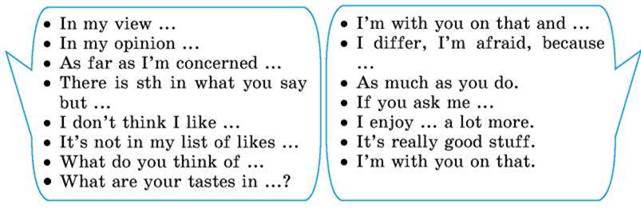
In the text, find the sentences with introductory phrases and reproduce them in context with correct information. Follow the intonation pattern.
Pattern:

1. Study the difference in meaning. In the text, find the sentences with these words and interpret their meanings in context. Make up your own sentences by analogy.
admission — permission given to someone to enter a building or a place. Example: The admission to the library is free. |
access — the right to use something, see something etc. Example: The access to the book is restricted. |
2. Match the words and phrases from the text to their explanations. Illustrate them in your own sentences.

Example: I’m a regular reader of the library magazine.
3. In the text, find the words and phrases attributable to the word ’library’. Use them to describe your school library.
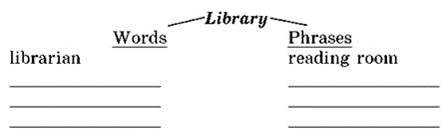
Example: The librarians of our school library often organize displays of new books.
1. From the text read out the sentences with the words in bold. Interpret their meanings in context.
Example: It might be useful. The verb ’might’ shows that a person isn’t certain.
2. In the text, find and reproduce the sentences with the modal verb ’can’. Complete the instruction.
The modal verb ’can’ may express…

3. Say what you may, can, must or might do at the library.
Example: The readers can borrow any book from the library.
IV. Communication Track
1. Speaking
a) Read some facts about famous libraries. Summarise the information and say why they are world famous.
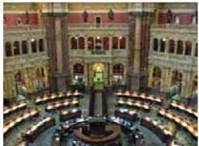
The Library of Congress
• the largest library of the USA;
• situated in Washington DC;
• set up in 1800;
• president Thomas Jefferson contributed his personal collection of 6,487 books;
• contains books in more than 450 languages;
• every book, magazine etc. that is produced in the USA has to give a copy to the library.

The British Library
• the largest library in the world by number of items catalogued;
• contains 170 million items from many countries, both printed and digital;
• located on the North side in St Pan- cras, London;
• sponsored by the Department of Culture, Media and Sport;
• founded on July, 1, 1973
• open to everyone who has a genuine need to use its collection;
• provides free online access to consulting reports, working papers and articles.
• the biggest library in Ukraine;
• one of the 10 biggest libraries in the world;
• set up on August, 25, 1918;
• located in Kyiv
• contains about 15 million items;
• serves as a scientific centre;
• prepares candidates and doctors of sciences.
b) Read and learn how to share opinions on books and characters. Look at the pictures and fill in the mini-dialogues. Pair up with your friend and make up a dialogue round one of the mini-dialogues.

The Vernadsky National Library of Ukraine
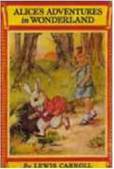
«Alice in Wonderland»
1) -__________ is an enjoyable reading, isn’t it?
- I disagree, I’m afraid, it is not on my list of likes.

«Oliver Twist»
2) - I dislike________ , it’s so dull.
- But in my opinion, it is good stuff, full of historical events.

«The Happy Prince»
3) - In my view, ____ is both for grown-ups and teenagers.
- I’m with you on that.

«Captain Grant’s Children»
4) - I think_______ is a book to read and re-read.
- If you ask me, I enjoy fantasy book a lot more.
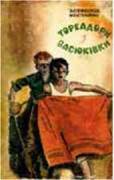
«Toreadors from Vasiukivka»
5) - What do you think of________________ ?
- Oh, I enjoy_________________ a lot more than other books.
c) In the whole class, debate over the statement:
«Time will come when libraries die out.»
2. Listening
a) Before you listen
Listen to the sentence from the story you are going to listen to and make a portrait of a girl.
’So on the afternoon of the day when her father had refused to buy her a book, Matilda decided to walk to the public library in the village all by herself’.
b) While you listen
Listen to a piece of story and choose a correct answer.
1. When did Matilda learn to read?
a) at the age of 5;
b) at the age of 3;
c) at the age of 10.
2. What did the girl ask her father about?
a) to buy her a book;
b) to switch on TV;
c) to go to the library with her.
3. Why was Mrs Phelps surprised?
a) the girl was very small;
b) the girl asked for serious books;
c) the girl was impolite.
4. How long did the girl spend in the library?
a) ten minutes;
b) the whole day;
c) two hours.
5. When did the girl need the librarian’s help?
a) when she had finished all books for children;
b) when she couldn’t reach books on the shelf;
c) when she couldn’t understand something.
6. What books did the girl want to read next?
a) books for curious children;
b) books for adults;
c) books for young girls.
c) After you listen
Say what children are usually regular readers of a library. How much true it is about you?
3. Writing
a) Before you write
If you intended to persuade readers to take part in the event that is going to happen, write an advertisement as a picture, a set of words or a short film.
• There will be an interesting meeting at your city library. Brainstorm with your friends what to write in the advertisement so that other students wanted to come.
• Make a list of words and phrases you’ll use to attract readers’ attention.
b) While you write
How to write an advertisement
Content Tips |
Language Tips |
• Think of an unusual beginning of your advertisement to encourage readers to participate in your activity • Focus on the most outstanding features of the activity • Try to accompany it with some photos or other illustrations • Be precise in time and place description |
• Are you interested in…? • Do you like…? • There is nothing more interesting that… • Come and… • Join us… • You’ll enjoy… |

At Home: In your WB, write an advertisement about any event in your library.
Перша публікація: 01/01/2016
Останнє оновлення: 31/12/2023
Редакційна та навчальна адаптація: Даний матеріал зведено на основі першоджерела/оригінального тексту. Команда проєкту здійснила редакційне оглядове опрацювання, виправлення технічних неточностей, структурування розділів та адаптацію змісту до навчального формату.
Що було опрацьовано:
- усунення форматних дефектів (OCR-помилки, розриви структури, дефектні символи);
- редакційне упорядкування змісту;
- уніфікація термінів відповідно до академічних джерел;
- перевірка відповідності фактичних тверджень тексту першоджерела.
Усі згадки про автора, рік видання та походження первинного тексту збережено відповідно до джерела.