Підручник Англійська мова 8 клас - Калініна Л.В. - Генеза 2016 рік
Unit 4 In the World of Mass Media
4.4. Radio News
Word Bank |
Phrase Bank |
✵ newscast |
✵ to break the news |
✵ to welcome the news |
|
✵ to hear on the news |
|
✵ to put on the news |
|
✵ a news broadcast |
|
✵ news network |
|
✵ a piece of news |
|
✵ current events |
Communication Box:
How to discuss the news
✵ Do you like to keep up with the news …?
✵ Are you currently following the news in …
✵ If you want to be in the know …
✵ I believe one of the good point about real news is that …
✵ The good thing about … is …
✵ It is concerned with …, isn’t it?
✵ Have you heard the latest news …?
✵ How can you account for …?
✵ I use the news at 7 o’clock to finally wake me up.
✵ We’ll put your favourite radio channel on.
✵ I think … was the most important news story last year.
✵ I’ll try to keep up to date.
✵ … provides details of the local news.
✵ … has many plus points, I believe.
✵ I think the downside of … is …
✵ … is a highly controversial issue.
✵ No news is good news, as the English proverb goes.
I. Now for it!
Look at the pictures and speak about these people’s preferences in listening to the radio. Say which pattern is yours.
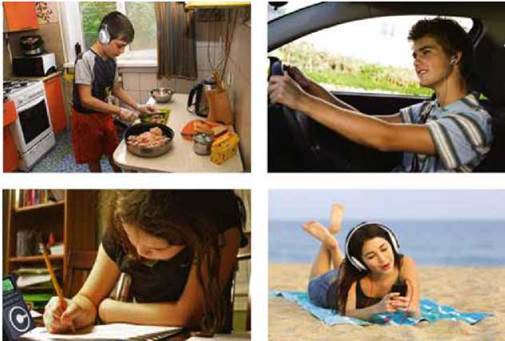
Example: The boy in the picture is helping his mother and listening to the music on the radio. I do the same every now and then. I usually switch on my favourite FM station.
II. Reading
a) Read the conversation of two friends discussing the radio news and say if they have the same interests.
Talking about the Radio News
Natalka: Hi, Pete, have you heard the latest news over the radio?
Pete: No news is good news, as the English proverb goes.
Natalka: Come on. It has been broadcast on all radio stations.
Pete: That’s the problem. I set the radio for an early hour in the morning to wake me up.
Natalka: It’s you all over. You should be in the know of what is going on around you.
Pete: I’m not a «radio» person, you know. I learn the news from the Internet or TV.
Natalka: So you do. But it happens … in the evening when you are back from school and then through with your home task. This is the downside of the Internet news, because you are in the dark all day long.
Pete: Don’t come an elder sister over me, Natasha. Break your news.
Natalka: Out football team «Shakhtar» has won! Now the Ukrainian footballers are world famous and all over the sport reporters pay credit to them for their spectacular achievements.
Pete: That’s a really good piece of news. All football fans welcome it, I suppose. Did you find out the score of the match?
Natalka: I was the first to know it. I’ve heard it on the news in the morning.
There’ll be a special issue of the news bulletin in a couple of minutes. Would you like to keep up with the news? I happen to have a small radio.
Pete: With pleasure. It may provide details about the match.
Natalka: No doubt. I think it’s the most important news of the day, so far. It’s not that bad to be in the know, is it?
Natalka: It isn’t. Switch on your radio, or we’ll miss it.
III. Language Track

1. In the text above, find 5 words in which ’er’, ’ear’, ’or’ and ’eir’ give the sound /ə:/ and reproduce them in contexts. Practise saying them in your own context.

1. Study the difference in meaning. From the text reproduce the words in the context and interpret their meaning. Make up your own sentences by analogy.
to learn (verb) — to hear news from someone else or read it |
to find out (verb) — to get information, after trying to discover it or by chance. |
Example: I learn the news from the Internet or TV. |
Example: Did you find out the score of the match? |
2. Explain what is meant by:
✵ a radio station;
✵ a radio person;
✵ a news bulletin;
✵ a special issue;
✵ a sport reporter;
✵ a news report.
2. In groups, present a news summary which may be based on the following headlines.

Use the following plan:
Time
 Place
People involved
Events
Cause
Consequences
Comments
Place
People involved
Events
Cause
Consequences
Comments

1. In the text above, find the sentences with the uncountable noun ’news’ and translate them into Ukrainian.
2. Complete the instructions and give your own examples.
✵ If you want to talk about the news, use …, but don’t use …
✵ If you want to ’count’ the news, use …

3. Fill in the articles if necessary.
1. ____good news is that tomorrow it will be fine and sunny.
2. What’s______ latest news?
3. No news is_____ good news.
4. David has just told me____ interesting piece of news.
5. Have you heard____ news?
6. Let’s watch_____ news report.

IV. Communication Track
1. Speaking
1. In pairs, look at these news photos. Say what is happening. Discuss which news you find the most interesting and why.

2. Read and learn how to discuss the news. Look at the pictures and fill in the minidialogues and make up your own round one of them.
1) - Hey … , have you heard the latest news about …?
- Sure. I think it is the most important news.
flood in the Carpathian Mountains
2) - Are you currently following … ?
- Yes. I’m trying to keep up to date.

world news
3) - If you want to be in the know about … in Ukraine, you should put on a culture radio channel.
- They say it provides details of cultural news.

cultural events
4) - The Verkhovna Rada channel is concerned with highlighting … , isn’t it?
- Exactly. The good thing about it is a many-sided presentation of political events.

home news
5) - I believe one of the good points about the radio … is that it is always up to the minute.
- It has many plus points, I believe.

sport news
6) - How do you account for … in the Black Sea?
- It’s terrible beyond words. It’s the downside of the Environment Policy.

water pollution
3. In the whole class, discuss your attitudes to the radio news using the questionnaire suggested.
Questionnaire
The News and Current Events
1. How much time do you spend learning about the news every day?
✵ no time ✵ 10 minutes ✵ more than 30 minutes
2. How do you learn about the news?
✵ radio ✵ TV ✵ newspapers/magazines ✵ Internet
3. Which news don’t you miss for anything?
✵ world news ✵ home news ✵ sport news ✵ music news
4. Which news do you never read/listen to/watch?
✵ business news ✵ weather ✵ local news ✵ other
5. Which is your favourite radio station?
✵ __________ ✵_____ ✵________ ✵ other
2. Listening
a) Before you listen
You are going to listen to a joke about the press. Try to predict its content with the help of these words.
✵ suggestions;
✵ paper;
✵ interesting;
✵ wastepaper basket;
✵ to carry out;
✵ office boy.
b) While you listen
Listen to the joke and say in what case ’to carry out’ is used as «виконувати». Try to guess the second meaning of this expression.
c) After you listen
Say which of the activities are similar to those in your school.
3. Writing
a) Before you write
If you want to break the news, write a news report.
✵ Say where news reports can be found and if they are popular in your country.
✵ Say when and why you read, watch or listen to news reports.
b) While you write
Follow the format of the notice.
How to write a news report
Content Tips |
Language Tips |
✵ News reports describe particular event on topic which is of interest to the readers. ✵ It is written in formal style and gives accurate facts only, not chatting descriptions. ✵ A good report should have short- eye catching headline, which introduces the subject of the report. ✵ News reports consist of: an introduction, which summarises the event giving information about the time, place and the people involved; a main body, in which the event is developed in details; a conclusion in which action to be taken or people’s comments on the event are given. |
✵ Today’s main story is about… ✵ According to… ✵ Local residents who witnessed … said that… ✵ … commented later… ✵ It was announced yesterday that… ✵ If you would like more information about … , please contact… |
At Home: Listen to the radio news, watch TV news, read newspapers or search the Internet and, in your W/B, write a brief report about the latest news you’ve heard.
Перша публікація: 01/01/2016
Останнє оновлення: 31/12/2023
Редакційна та навчальна адаптація: Даний матеріал зведено на основі першоджерела/оригінального тексту. Команда проєкту здійснила редакційне оглядове опрацювання, виправлення технічних неточностей, структурування розділів та адаптацію змісту до навчального формату.
Що було опрацьовано:
- усунення форматних дефектів (OCR-помилки, розриви структури, дефектні символи);
- редакційне упорядкування змісту;
- уніфікація термінів відповідно до академічних джерел;
- перевірка відповідності фактичних тверджень тексту першоджерела.
Усі згадки про автора, рік видання та походження первинного тексту збережено відповідно до джерела.