Підручник Англійська мова 7 клас (8-й рік навчання) - Алла Несвіт - Генеза 2016 рік
UNIT 5 Countries, People, і Lifestyle: The UK and Ukraine
Lesson 6. Whatever the Weather
1. Look at the pictures. Say:
✵ what season it is;
✵ what the weather is like;
✵ what clothes you usually wear on such a day.
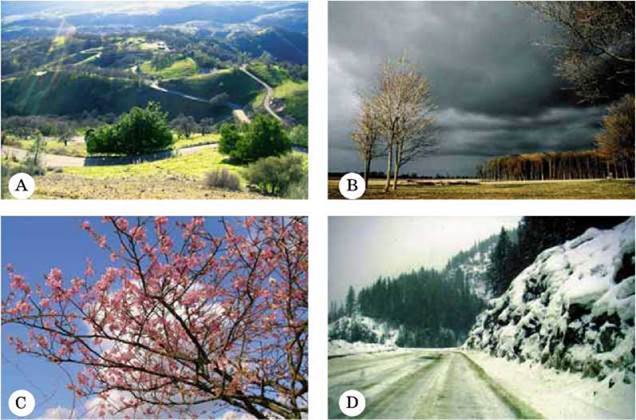
2. Put the following adjectives into two columns: fine weather, nasty weather. What
season of the year do these adjectives describe?
Cloudy, rainy, misty, snowy, foggy, sunny, hot, wet, cold, dull, calm, stormy, windy, bright, clear, warm, cool.
3. Listen and read the dialogue. Match it to one of the pictures of Ex. 1.
A: Nice day, isn’t it?
B: Yes, it is. It’s a perfect day for staying outside!
A: I enjoy this time of the year. It’s often sunny and warm. You don’t have to put much clothes on.
B: But you can’t know for sure what the weather will be like in the afternoon. Yesterday I was caught in the rain and got wet through.
A: You mustn’t forget that you’re in Scotland. It rains nearly every day here. So you have to take your umbrella with you all the time.
B: That’s good advice. Now I know that.
Learning Strategies: Talking About the Weather
People often talk about the weather. It is a way to greet someone you pass on the street. It’s a way to begin a conversation with someone you don’t know at a social event. Conversations about the weather are never very long. They are usually only openers to other subjects. A comment about a nice day or a personal complaint about the rain is an easy way to break the ice.
Here are some comments about the weather:
Nice day, isn’t it? Hot enough for you? I’m boiling!
Looks like rain to me.
A little on the cool side, isn’t it?
It’s pouring down today.
It’s a perfect day for staying outside!
I can’t stand it. It’s freezing!
This rain hasn’t let up for two weeks.
I’m going crazy! Gee, it’s slippery out there.
Isn’t it beautiful out today? Are you joking? I’m soaking wet!

4. Work in pairs. Use the phrases from the table above to talk about the weather in the pictures of Ex. 1 on p. 126.
5. Write the second sentence so it means the same as the first. Use the modal verbs.
1. Ann says, «Don’t forget to take an umbrella with you. It’s going to rain.» - Anns says, «You should take your umbrella with you. It’s going to rain.»
2. Steve says, «It doesn’t usually rain hard in September here.»
3. Pamela says, «We don’t usually get so much snow in December.»
4. Ramona says, «Don’t put a warm sweater on, Jack!»
5. Dennis says, «You have soaked wet. Give me your jacket and hat to dry.»
6. Sue says, «It’s too windy for a picnic.»
7. Mr. Stevenson says, «The weather has already changed today.»
8. Mrs. Brown says, «Put the right clothes into your suitcase!»
6. Write a few sentences about your favourite season of the year. What activities enjoy the greatest popularity among the teenagers?
Перша публікація: 01/01/2016
Останнє оновлення: 31/12/2023
Редакційна та навчальна адаптація: Даний матеріал зведено на основі першоджерела/оригінального тексту. Команда проєкту здійснила редакційне оглядове опрацювання, виправлення технічних неточностей, структурування розділів та адаптацію змісту до навчального формату.
Що було опрацьовано:
- усунення форматних дефектів (OCR-помилки, розриви структури, дефектні символи);
- редакційне упорядкування змісту;
- уніфікація термінів відповідно до академічних джерел;
- перевірка відповідності фактичних тверджень тексту першоджерела.
Усі згадки про автора, рік видання та походження первинного тексту збережено відповідно до джерела.