Підручник Англійська мова 7 клас (8-й рік навчання) - Алла Несвіт - Генеза 2016 рік
UNIT 5 Countries, People, і Lifestyle: The UK and Ukraine
Lessons 3-4. Teenage Leisure
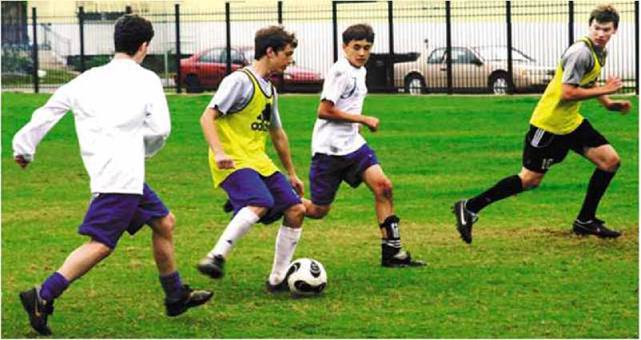
1. Look at the pictures. What are the teenagers doing? Which activities do you do?

2. You are going to read the text about the way teenagers spend their free time in the UK. Choose the most suitable heading from the list (A-E) to each part (1-4). There is one extra heading which you do not need to use.
A Eating out
B Two Common Leisure Activities in the UK
C Computer Games and Television
D Entertaining and Cinema E Doing Sport
How Do Teenagers in the UK Spend Their Free Time?
Teenagers in the UK enjoy various indoor and outdoor activities. A recent survey discovered that they spend about 45 % of their free time playing computer games and watching television, 24 % of their free time socializing, 22-23 % on sport and hobbies, and 10 % on other activities. Other popular leisure activities are listening to the radio, listening to pre-recorded music, reading, DIY*, chatting online, eating out and going to the cinema.
1. ________________________________________________
Playing computer games ranks the first place in the list of the favourite activities among the teenagers. The second most common leisure activity in the UK is watching television. The average viewing time is 25 hours per person per week. Many television programmes are about wildlife, animals, holidays, cooking and gardening. Teenagers watch TV before and after school.
2. _______________________________________________
Visiting or entertaining friends or relatives and going to the cinema are also very popular activities in Britain.
3. ______________________________________________
Teenagers go to McDonalds or King’s Burger at least once a week. Sometimes they have a pizza delivered to their houses or go to a restaurant with their family at the weekend.
4. ________________________________________________
Sports and physical recreation have always been popular. Local governments provide cheap sport and leisure facilities such as swimming pools, tennis courts, parks and golf courses. People go to watch other people play sports like football or take part in sports activities themselves.
3. Read the text of Ex. 2 on p. 120 again. Say what activities enjoy the greatest popularity in the UK.
4. Listen to the Ukrainian children talking about their favourite pastime. Tick (x) the things they enjoy doing.
Activities / Names |
Dan |
Ann |
Maksym |
Travelling |
|||
Listening to music |
|||
Drawing |
|||
Going to the theatre and cinema |
|||
Playing computer games |
|||
Chatting online |
|||
Doing sport |
|||
Going out with friends |
5. Complete the sentences with the names of the children. Which statements are also true for you?
1. ….. is very keen on sport.
2. ….. spends a lot of money on computer games.
3. ….. spends two or three hours a day chatting online.
4. ….. enjoys going to the theatre and to the cinema more than doing sport.
5. ….. thinks that a good hobby can become a future profession.
6. spends school holidays visiting different places in Ukraine and abroad.
6. Play a guessing game.
Work in small groups. One pupil describes one of the activities in the list on page 122. Others have to guess what activity he / she is talking about.
Example:
A: To my mind, this activity is very popular with the teenagers around the world. They usually spend a lot of time outdoors, visit the places they have never been before and enjoy discovering the mysteries of the surrounding world.
B: Is it travelling?
A: Yes, it is.
Free Time Activity |
Word Combinations to Describe the Activity |
Travelling |
to unlock the door to nature’s secrets, to enjoy picturesque places, to watch birds and animals, to admire the countryside, to spend a lot of time outdoors, to climb the mountains, to discover the mysteries of the surrounding world |
Listening to music |
to collect records and CDs, to go to the concerts, to play the musical instrument, to do dancing, to record music on the MP-3 player or a mobile phone |
Playing computer games |
to play on somebody’s own, to relax, to spend money on computer games, to exchange the games with friends |
Chatting online |
to surf the Internet, to meet people from all over the world, to exchange information, to send electronic messages |
Doing sport |
to keep fit, to have a good posture, to play active games, to have enough energy, to develop good character, to take up yachting |
Drawing |
to collect books on Art, to take lessons of drawing, to draw portraits and landscapes, to make sketches outdoors, to go to picture galleries |
Going to the cinema or to the theatre |
to read books about theatre, to watch performances and films, favourite actors and actresses, expensive / cheap seats |
Going out with friends |
to communicate, to discuss, to go dancing in clubs, to share interests, to go for a picnic, to eat out |
7. Work in pairs. Discuss your hobbies with your friend. Use the phrases from Ex. 6 and the expressions given below.
I enjoy doing …
I really like / don’t like doing … I quite like doing …
I prefer … (doing sport) to … (chatting online)
Example:
A: What do you like doing in your free time, Svitlana?
B: I enjoy travelling and taking pictures. You can discover the mysteries of the surrounding world and admire the picturesque places.
A: Me too. But I really don’t like travelling on foot especially on hot weather.
B: So do I. I usually go hiking with my classmates in late spring or early autumn. The days are perfect then. In summer I mostly spend much of my free time at the seaside.
A: And what do you like doing at the weekends?
B: I love chatting online and drawing. I draw portraits and landscapes. I think that drawing can become my profession in future. I have participated in some exhibitions and rather successfully. Would you like to see my pictures?
A: Sure! Good idea.
B: I’m waiting for you on Sunday then.
8. Write a few sentences about your favourite free time activities.
Перша публікація: 01/01/2016
Останнє оновлення: 31/12/2023
Редакційна та навчальна адаптація: Даний матеріал зведено на основі першоджерела/оригінального тексту. Команда проєкту здійснила редакційне оглядове опрацювання, виправлення технічних неточностей, структурування розділів та адаптацію змісту до навчального формату.
Що було опрацьовано:
- усунення форматних дефектів (OCR-помилки, розриви структури, дефектні символи);
- редакційне упорядкування змісту;
- уніфікація термінів відповідно до академічних джерел;
- перевірка відповідності фактичних тверджень тексту першоджерела.
Усі згадки про автора, рік видання та походження первинного тексту збережено відповідно до джерела.