Підручник Англійська мова 7 клас (8-й рік навчання) - Алла Несвіт - Генеза 2016 рік
UNIT 3 Books and Writers
Lessons 3-4. Books Today
1. Look at the pictures. Say how the book has changed since ancient times.

The Celts / to carve runes on the stones
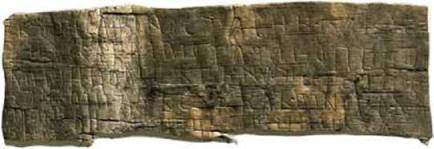
The Slavs / to write on the bark of a birch tree

Egyptians / to use papyrus

Modern people / to print books
Example:
Egyptians used papyrus to write on.
2. Work in pairs. Act out a dialogue. Talk about the role of books in people’s life.
Example:
A: What can we learn from ancient manuscripts?
B: They provide us with facts about life in the past, explain how the life has changed over the centuries.
A: I think we’re really lucky to have books today! Five thousand years ago in Mesopotamia, the Sumerians tied their clay tablets together with twine and stored them in baskets. At about the same time in history, Egyptian scribes kept track of papyrus scrolls in the temples, but the average Egyptian never saw those books and definitely couldn’t take them home!
B: These were the Greeks who gave everyone access to books. Their libraries contained scrolls 1 on all subjects ranging from mathematics to myths. They built the most magnificent library in the world in Alexandria. …
1 Scrolls - рулони манускриптів.
Reading Lab
3. Read the text and choose the best title for it.
A THE FUTURE OF THE BOOK
B READING IN THE FUTURE
CALL BOOKS ARE HERE TO STAY
(1) Today e-book reading is increasing around the world! By 2014 28% of adults had read an e-book, compared to 23% in 2013. This is happening because 50% of American adults by 2014 had either an e-reader or a tablet, compared to 30% owing such a device by the end of 2013. With time, these gadgets will be used more and more, and electronic books will be read by almost everybody. However, I don’t believe that traditional books will ever completely disappear.
(2) Reading an e-book has certain advantages over reading traditional books. The biggest of these is that you can adjust the size of the text. You don’t have to find a paper book in large text. You simply make the text larger on your device. Also, e-books are lightweight and take up practically no storage space. Since one device can hold hundreds of books, when you travel you can take your entire book library with you. Furthermore, e-books are convenient. You can purchase a book directly from your mobile phone, tablet, or e-reader. The moment you pay for it, the text will be shown on your screen. But, when you buy an e-book, you just rent it or pay for access to it under a specific set of rules.
(3) The advantage of a paper book is that you don’t have to worry about the type of technology. You simply pick up the book and read. Moreover, paper books are somehow comforting. You can create a home library of your favourite ones.
(4) It seems that in life there are always pluses and minuses. As for me, I will continue to both own and display my paper books and read e-books on my smart phone and tablets. I am sure I will be joined by other book lovers around the world.
4. Answer the questions.
In which paragraph of this article can we find:
✵ the personal opinion of the writer?
✵ a thought provoking fact to get the reader interested in the subject?
✵ the emphasis on the difference between owning a traditional paper book and an e-book?
✵ an argument about which type of books will be used in future?
Grammar Lab: Future Simple Passive Voice
We form the Passive Voice by means of the verb to be and the third form (Past Participle) of the main verb.
Future Simple Passive Voice
will be + V 3
|
Positive |
Negative |
||||
I / We |
will (shall) be |
visited. built. |
I / We |
won’t (shan’t) be |
visited. built. |
You / They / He / She / It |
will be |
You / They / He / She / It |
won’t (will not) be |
||
Question |
Answer |
Will (Shall) I be visited by my friends tomorrow? Will it be built by builders? Will they be visited by their relatives? |
Yes, I will (shall). / No, I won’t (shan’t). Yes, it will. / No, it won’t (will not). Yes, they will. / No, they won’t (will not). |
Compare:
They will remove the bark from the log. (Active Voice.) The bark will be removed from the logs. (Passive Voice.)
5. a) Look through the text of Ex. 3 on p. 67. Find and write down the sentences in the Future Simple Passive Voice.
b) Ask and answer questions to these sentences.
Example:
In future electronic books will be read by almost everybody.
Will electronic books be read by almost everybody in future?
In future electronic books won’t be read by almost everybody.
6. Write sentences in the Future Simple Passive Voice. Use the verbs from the word bank.
✵ to give ✵ to show ✵ to build ✵ to publish ✵ to tell ✵ to meet ✵
1. The film about Tom Sawyer….. on TV tonight.
2. The new library …… in the city centre.
3. The writer ….. at the airport tomorrow.
4. An interesting fairy tale ….. in the evening.
5. This book …… next week.
6. The last issue of the magazine…. in three days.
Conversation Lab
7. Look and order the pictures. Describe the process of making a book. Use the Future Simple Passive Voice.
Use the words:
✵ to start work ✵ to cut the trees ✵ to peel away the branches ✵ to get the logs to the woodworking plant ✵ to remove the bark ✵ to chop up ✵ to roll out into ✵ long story ✵ to wind who ✵ lange roll ✵

8. Put the verbs in brackets into the Future Simple Passive Voice. Then write negative sentences and questions.
1. This book …. (to discuss) during the lesson of World Literature.
2. The pupils of our class …. (to take) on an excursion next Friday.
3. The compositon about Rob Roy ….. (to write) tomorrow.
4. The catalogue of books ….. (to make) next week.
5. The dictionary ….. (to use) while reading the text in English.
6. This information ….. (to include) in the new edition of the encyclopedia.
7. The school library ….. (to visit) tomorrow.
Перша публікація: 01/01/2016
Останнє оновлення: 31/12/2023
Редакційна та навчальна адаптація: Даний матеріал зведено на основі першоджерела/оригінального тексту. Команда проєкту здійснила редакційне оглядове опрацювання, виправлення технічних неточностей, структурування розділів та адаптацію змісту до навчального формату.
Що було опрацьовано:
- усунення форматних дефектів (OCR-помилки, розриви структури, дефектні символи);
- редакційне упорядкування змісту;
- уніфікація термінів відповідно до академічних джерел;
- перевірка відповідності фактичних тверджень тексту першоджерела.
Усі згадки про автора, рік видання та походження первинного тексту збережено відповідно до джерела.