Підручник Англійська мова 7 клас (8-й рік навчання) - Алла Несвіт - Генеза 2016 рік
UNIT 2 School Life
Lesson 9. After School
1. Work in pairs. Take turns to ask and answer the questions.
1. What after-school activities can children take up?
2. What clubs and sections do you have in your school?
3. How can attending any club be effective in your studies at school?
4. Do you attend any club or section?
5. Who helped you choose after-school activities for yourself?
2. a) Work in pairs. Look at the photos and discuss the questions.
b) Say which of these after-school activities you would like to take up.
• Do you think the children are enjoying themselves? (Why? / Why not?)
• What effects does the participation in the school clubs have on their personal development?
• Is there a relationship between somebody’s interests and their personality? (Why? / Why not?)
• Is it possible to attend a few clubs at a time?
• Do you think extra-curricular activites are an important part of school life? ( Why? / Why not?)


3. Read the article from a teenage magazine. What new pieces of advice have you found for yourself?
How Can You Get Involved?
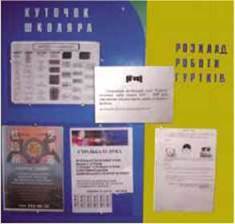
At the beginning of the school year schoolchildren decide which after-school activity to take up. Teachers often make announcements about those in your school. For example, your history teacher may be the debating team advisor.
Look on school bulletin boards and in the school newspaper. Ask friends what they like.
Talk to the activity advisor before you join.
You can ask about:
• Age. You may join an activity at a certain age only.
• Physical condition. Talking with your family doctor may help you decide whether a club is a good choice for you.
• Marks. Many groups require high marks in school subjects to join.
• Time. If you’re involved in competitive sports, you need to have enough time to practise and compete.
Each school has its own list of after-school activities. If you don’t find what you want, try other clubs in the place where you live.
4. Read and complete the sentences.
1. At the beginning of the school year, teachers often ….. .
2. You can find announcements ….. .
3. Ask your friends what ….. .
4. Some things to decide before joining any club include …
5. Each school is unique with its own.
6. If you don’t find what you want in your school, you can
Conversation Lab: Discussing the Choice of After-School Activities
5. a) Listen and read the dialogues.
1.
A: Hi, Steve! Have you read the announcement on the school bulletin board?
B: Do you mean the one which invites the 10-13 year olds to join one of the school sports clubs?
A: Yes, I do. What about joining the basketball club? I think we both have the physical conditions it requires.
B: Your idea sounds really great. Do you have enough time to practise three times a week?
A: I hope I do. Nevertheless, I’ll have to make changes in my daily timetable.
2.
A: Did you know that the new tennis club is opening in our school next year?
B: Yes, Nick has told me about that.
A: Are you going to attend it?
B: Yes, I believe I can become a good part of the school team.
A: Actually, I have joined the club, too.
b) Work in pairs and act out similar dialogues with your friend. Use the information from Ex. 3 on p. 52.
6. Complete the text with the words from the box. Put them into the correct tense form.
• to quit • to enjoy • to plan • to rejoin • to keep • to think • to explain • to take up • to feel (x2) • to join • to take • to improve •
Too Much of a Good Thing?
Once you (1) …. an activity, you have (2) ….. it. You mustn’t (3) …. stressed. It’s important (4) ….. a balance between schoolwork, after-school activities, and your health. If you (5) ….. a club and need (6) ….. for any reason, (7) ….. with the teacher or coach. Be direct and polite and (8) ….. your situation and feelings. Sometimes it’s just not the right choice for you or it (9) ….. too much of your time. Perhaps you have (10)….. your schedule better, (11) ….. your marks in some of the school subjects and (12) …… later. Saying «no» can be the most responsible thing to do.
Перша публікація: 01/01/2016
Останнє оновлення: 31/12/2023
Редакційна та навчальна адаптація: Даний матеріал зведено на основі першоджерела/оригінального тексту. Команда проєкту здійснила редакційне оглядове опрацювання, виправлення технічних неточностей, структурування розділів та адаптацію змісту до навчального формату.
Що було опрацьовано:
- усунення форматних дефектів (OCR-помилки, розриви структури, дефектні символи);
- редакційне упорядкування змісту;
- уніфікація термінів відповідно до академічних джерел;
- перевірка відповідності фактичних тверджень тексту першоджерела.
Усі згадки про автора, рік видання та походження первинного тексту збережено відповідно до джерела.