Підручник Англійська мова 7 клас (7-й рік навчання) - Карпюк О. Д. - Астон 2015 рік
Unit 3 A SOUND MIND IN A SOUND BODY
✵ Sports from A to Z
✵ Doctor! Doctor!
Pre-reading questions
Are you a sports fan?
Do you know anything about the Olympic Games?
Who is your favourite sportsman?
How many of your classmates are absent today? Why?
Have you ever seen a doctor?
What should you do to keep fit?
Lesson 1 SPORTS FROM A TO Z
VOCABULARY
1. Look at the different sports.
Match the pictures with the words on page 93.

□ wrestling |
□ judo |
|
□ climbing |
□ golf |
|
□ figure skating |
□ water polo |
|
□ bobsleigh |
□ snowboarding |
□ handball |
□ ice-hockey |
□ skateboarding |
□ fencing |
2. Name sports in each group below without looking back at the previous page.
winter sports / water sports / team sports / outdoor sports / sports that are played with the ball / indoor sports
3. Group up the sports into 3 columns.
Mind 1 the verbs you use with each sport.
rugby, cricket, soccer, rowing, cycling, basketball, tennis, boxing, karate, volleyball, skiing, judo, horse riding, sailing, swimming, high jump, running, gymnastics, athletics, wrestling
PLAY |
GO |
DO |
READING
1. Answer the questions.
How often do the Olympic Games take place?
Who can take part in the Olympic Games?
What is the motto 2 of the Olympic Games?
2. Read the first paragraph of the text on page 94 and check your answers.
1to mind [maınd] — бути уважним, пам’ятати
2a motto ['mɒtəƱ] — девіз
3. Read the rest of the text and find the correct headings
for each paragraph.
THE OLYMPIC FLAG
MEDALS
THE PARALYMPIC GAMES
THE WINTER OLYMPICS
THE OLYMPIC MASCOT
THE OLYMPIC FLAME
THE SUMMER OLYMPICS
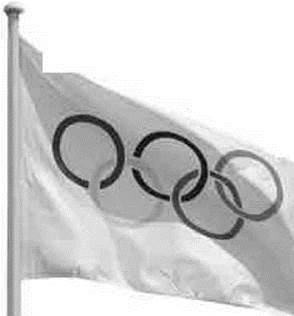
The Olympic Games are a modern international sports event. The best sportsmen from many countries all over the world compete in different sports. The games take place every four years in a different country. All sportsmen are proud to represent their country.
The motto of the Olympic Games is: SWIFTER, HIGHER, STRONGER.
This is one of the symbols of the games. It has a white background with five interlocking rings: blue, yellow, black, green and red. Why these six colours? Because they appear on all the national flags of the world. The five rings represent the five inhabited continents of the world: America, Europe, Asia, Africa and Oceania.

This is a character that represents the country where the Olympic Games are taking place but also the Olympic spirit. It is usually an animal: a tiger (Seoul, 1988), a dog (Barcelona, 1992) an eagle (Los Angeles, 1984). But it can also be a creature: Fuwa (Beijing, 2008), Wenlock and Mandeville (London, 2012).

The best athletes in each sports event get medals: gold for the first place, silver for the second place and bronze for the third place. However, the most important thing about the games is not to win, but to take part.

This tradition comes from a long time ago — from ancient Greece. Months before each games, a torch is lit at Olympia in Greece and sportsmen carry it across the world to the city where the new Olympic Games take place. The flame travels through many countries and it remains lit until the last day of the games. During the closing ceremony, it is put out.
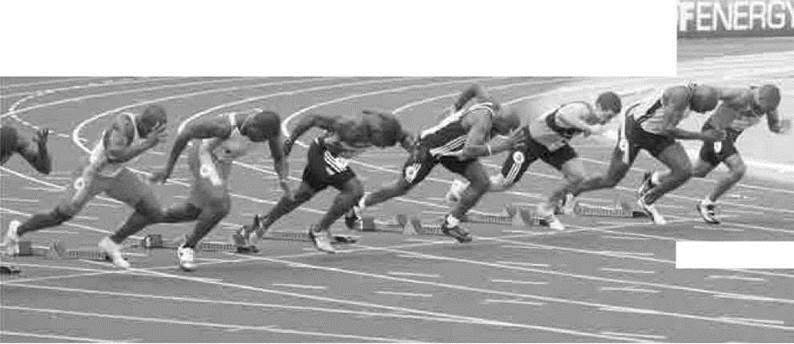
During the two to three summer weeks, athletes compete in more than 30 sports disciplines: gymnastics, athletics, rowing, sailing, badminton, wrestling and many others. The modern Summer Olympics started in 1896.

The Paralympic Games are the games for athletes with a disability 1. They are held every four years in the same year as the Olympic Games. They are parallel to the Olympic Games and that is where their name comes from. Thousands of athletes from many countries compete in the events such as: wheelchair basketball, cycling, swimming, track and field events, wheelchair tennis and many other events.
Figure skating, ice hockey, skiing, snowboarding and bobsleigh are some of the ice and snow sports that you can see during the games. There aren’t so many sports as during the Summer Olympics, but they are also interesting. The first Winter Games were organised in France in 1924.

disability [,disə'bılıtı] — неповноспраність, фізичні вади
4. Correct the sentences below.
1 The Olympic Games take place every five years.
2 There are six colours on the Olympic flag: white, pink, yellow, brown, grey and red.
3 The Olympic mascot is a building that represents the country where the games take place.
4 The Summer Olympics last for 2 to 3 months.
5 The most important thing about the games is to win.
6 The Winter Olympics are older than the Summer Olympics.
7 The Olympic flame is lit during the opening ceremony.
8 The Paralympic Games are the games for senior athletes.

5. Work in pairs. Take turns and speak about everything you remember about the Olympic Games.
6. Work in groups. Make a Sports ABC.
1 Think of a sport for every letter of the alphabet.
2 Do some research work in groups.
3 Design your poster.
4 Present your poster to your classmates.
The group with the longer list is the winner!

GRAMMAR
1. Read and compare short questions at the end of thesentences in both columns.

✵ I am 14, aren’t I?
✵ We are waiting for you, aren’t we?
✵ He has been here before, hasn’t he?
✵ You were watching a film, weren’t you?
✵ She has left, hasn’t she?
✵ You can swim, can’t you?
✵ We will go, won’t we?
✵ You like Coke, don’t you?
✵ We passed the test, didn’t we?

✵ This car isn’t expensive, is it?
✵ They are not selling it, are they?
✵ It wasn’t here yesterday, was it?
✵ We were not thinking about it, were we?
✵ They haven’t given us a price, have they?
✵ You can’t afford anything, can you?
✵ They won’t stay here, will they?
✵ We don’t live alone, do we?
✵ I didn’t say this, did I?
REMEMBER!
A question tag is a short question at the end of a statement 1. The verb that we use in the tag depends on 2 the verb in the statement.
Positive statements have negative question tags.
The boys like the bikes, don’t they?
Negative statements have positive tags.
They don’t really need the bikes, do they?
Read p. 211(Розділові питання)
1a statement ['steitment] — твердження
2to depend (on) [di'pend] — залежати (від)
2. Write the negative form that you would use in a question tag.
1 |
ARE |
7 WILL |
2 |
CAN |
8 HAS |
3 |
SHOULD |
9 DO |
4 |
WERE |
10 WOULD |
5 |
DID |
11 IS |
6 |
DOES |
12 WAS |
3. Complete with the question tags.
A: You are from Great Britain, …?
B: Yes, I am.
A: You have just arrived in the USA, …?
B: No, I arrived three months ago.
A: The weather is better here, …?
B: Yes, much better.
A: You have a lot of rain in Great Britain, …?
B: Oh, yes.
A: Our school system interests you, …?
B: Yes, it does. It’s different from ours.
A: You visited my school yesterday, …?
B: Yes I did.
4. Complete with the correct question tags.
1 Apples aren’t expensive, …
2 We won’t buy any fruit today, …
3 Paris isn’t the capital of Portugal, …
4 You wouldn’t like to be a dentist, …
5 The Smiths don’t travel much, …
6 Your parents haven’t been abroad, …
7 Little Billy doesn’t go to school yet, …
8 Teachers shouldn’t be too strict, …
9 You didn’t arrive on time, …
10 Our neighbours can’t drive, …
5. a) Make positive statements with negative question tags using the verbs in brackets.
1 Paul … a cat, …? (have got)
2 Jerry and Tim … football, …? (like)
3 Mary is crazy about swimming. She … swimming every week, …? (go)
4 I came home at four. You … here at four too, …? (be)
5 Pandora was busy last weekend. She … her room all weekend, …? (paint)
b) Make negative statements with positive question tags using the verbs in brackets.
1 You … that film yesterday, …? (see)
2 Most people here … English, …? (speak)
3 Henry … good marks, … ? (have got)
4 We … out tomorrow, …? (go)
5 There … a shop in this street, …? (be)
LISTENING
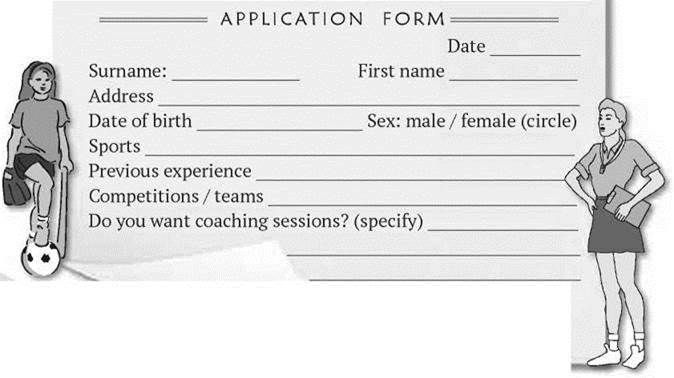
1. Copy the form. Then listen to the dialogue and complete it
RICHMONDS SPORTS CLUB
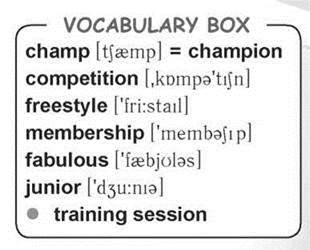

squash [skwɒʃ]
2. Listen again and match each sentence with the correct question tag from the box.
1 Your full name is Naima Abawickrama , ….?
2 You don’t live in Richmonds Club, ….?
3 You aren’t sixteen yet, …?
4 You want to play squash,…?
5 You were in your school swimming team last year, …?
6 You won the school 100 m freestyle race, …?
7 You’ve never played squash before, …?
|
Question tags |
|
a |
are you? |
b |
didn’t you? |
c |
isn’t it? |
d |
do you? |
e |
have you? |
f |
don’t you? |
g |
weren’t you? |
3. Work in pairs. Imagine you are applying 1 to a sports club. Copy the application form from task 1 again and complete it for yourself. Give the form to your partner. He / she will check it like this:
A: Your name is …, isn’t it?
B: Yes, it is.
1to apply [ə'plaı] — звертатись з проханням, подавати заяву
4. Guess what these words mean. Check their meanings with your friend, your teacher or the vocabulary at the end of the book.
a visiting team |
a goal |
a home team |
an attacker |
a penalty |
a foul |
a defender |
a referee |
to score |
a whistle |
a goalkeeper |
to cheer |
5. a) Before listening say what you know about water polo and its popularity around the world.
b) Read, listen and complete the rules.
Adrian and Celia are preparing to watch a water polo match.
Celia doesn’t know anything about this sport, so Adrian is explaining the rules.
WATER POLO RULES
1 Number of players in each team: …
2 The game has … parts
3 Each part lasts … minutes
4 Size of the pool: … metres long, … metres wide
5 Colour of the ball: …
6 After a foul the referee can send out the player for … seconds
7 After a bad foul there can be a penalty shot from … metres

REMEMBER!
MEASUREMENTS AND TIME
100 centimetres = 1 metre
1000 metres = 1 kilometre
60 seconds = 1 minute 60
minutes = 1 hour
The pool is 20 metres long
and 10 metres wide.
Each part is 5 minutes long.
It lasts 5 minutes.
6. Listen, then read what Celia and Adrian are talking about while they are watching the match. Try to understand what is going on, then complete the sentences.
1 Brian’s team, the home team, are wearing … caps.
2 Brian is a … player.
3 The referee is blowing the whistle for the … of the game.
4 … is shooting a penalty from five metres.
5 At the end of the match the score is … .
Celia: Why are Brian’s team wearing dark caps?
Adrian: Because these are the rules. The home team always wear dark caps. The visiting team wear white caps. Celia: What do you think? Is Brian a good player?
Adrian: He’s brilliant. He’s the best.
(whistle)

Celia: Why is the referee blowing the whistle?
Adrian: The referee always blows the whistle at the beginning.
Celia: Look at Brian! What is he doing?
Adrian: He’s trying to get the ball for his team.
Adrian and Celia: Go, Brian, go!!! You’ve got it!!!
Adrian: The score is 2-2! It’s still a draw and it’s nearly the end of the game.
Celia: Cheer up! Brian’s team have the ball.
Adrian: Oh, no! That’s a foul!! (whistle)
Celia: What is Brian doing?
Adrian: He’s getting ready to take the penalty.
Celia: Why is Brian taking the penalty?
Adrian: After a bad foul the other team gets a penalty from five metres. And stop asking so many questions and watch the match! You’re making me nervous.
Adrian and Celia: GOAL!! Way to go Brian! 3-2! We’ve won!

REMEMBER!
SPORTS SCORES
The score is 4-3.
Manchester beat Leeds 4-0.
The score is 2-2.
She won the first set 6-0. (tennis)
Read: four three
Read: four nil
Read: it’s two all, it’s a draw.
Read: six love
7. a) Answer the questions.
1 Are Adrian and Celia watching a handball match?
2 Are they cheering?
3 Is Brian playing well?
4 Why is the referee blowing the whistle?
5 Who is shooting the penalty?
6 Why is Celia asking a lot of questions?
b) Say if the sentences are true or false.
1 I watch TV every Sunday afternoon.
2 "What are you doing?» "I’m reading.»
3 Celia always asks too many questions.
4 Brian plays water polo every day.
5 James sometimes bites Brian’s finger.
6 Look! Brian is daydreaming again!
SPEAKING
1. Work in pairs. Ask and answer the questions.
✵ Do you do any sports?
✵ Which sport can you do at school?
✵ Do you like watching sports?
✵ Would you like to try playing water polo?
✵ Which are the most popular sports in Ukraine?
✵ What is your favourite sportsman or team?
2. Read and complete the fact file on page 106 in your copybook. Then answer the questions below.
MICHAEL SCHUMACHER
1 Michael Schumacher, or Schumi, is a very famous racing car driver. He’s got lots of fans around the world.
2 Michael comes from Germany. He was born on the 3rd of January, 1969. He is rather tall and thin with short dark hair. Michael can drive very fast cars. He can also play football and tennis very well.
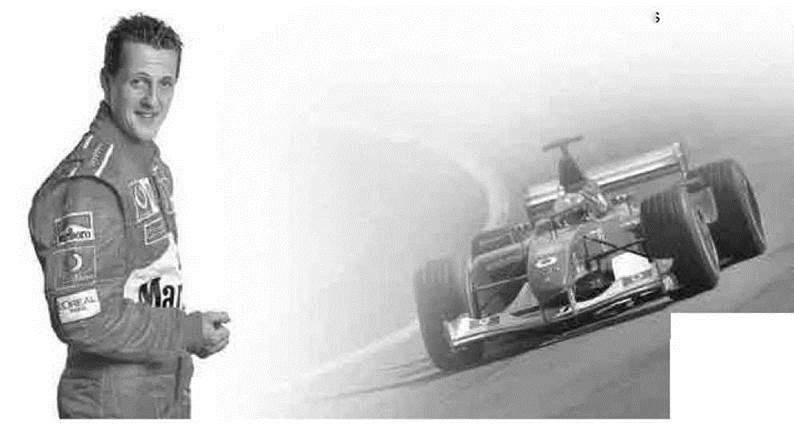
3. Michael is Ferrari’s best Formula 1 driver. «I’ll do everything I can to bring the Number One to Ferrari», he says. «The whole team and the fans deserve it.»
Michael Schumacher Full Name:… .
Occupation: ………………………..
Team: ………………………..
Born:
Personal details: ……………………….
Which paragraph includes:
✵ the personal details and hobbies?
✵ what he is famous for?
✵ the company he works for and his quote 1?
3. Look at the fact file below and present Kimi Raikkonen to the class.
Name: Kimi
Surname: Raikkonen
Nickname: lceman
Occupation: Racing car driver
Nationality: Finnish
Born: 17 th October, 1979
Personal details: short blond hair
Hobbies: snowboarding, jogging, ice-hockey
Current Team: McLaren Mercedes
1a quote [kwəƱt] — цитата

WRITING
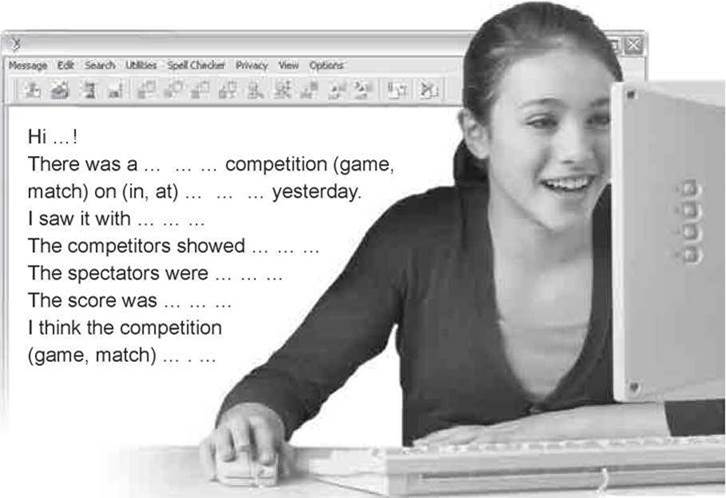
1. Write an e-mail to your friend describing a recent sport event you watched. Use the questions and the example below.
✵ Where and when did it take place?
✵ Did you watch it at the stadium or on TV?
✵ Who did you go there with?
✵ What sort of match or game was it?
✵ Who won?
✵ Did you enjoy it?
2. Write a paragraph about your favourite sportsman / woman.
✵ What sport does he/she do?
✵ Make a list of his/her achievements.
✵ What traits of character does he/she have?
✵ Why do you like him/her?
Перша публікація: 01/01/2015
Останнє оновлення: 31/12/2023
Редакційна та навчальна адаптація: Даний матеріал зведено на основі першоджерела/оригінального тексту. Команда проєкту здійснила редакційне оглядове опрацювання, виправлення технічних неточностей, структурування розділів та адаптацію змісту до навчального формату.
Що було опрацьовано:
- усунення форматних дефектів (OCR-помилки, розриви структури, дефектні символи);
- редакційне упорядкування змісту;
- уніфікація термінів відповідно до академічних джерел;
- перевірка відповідності фактичних тверджень тексту першоджерела.
Усі згадки про автора, рік видання та походження первинного тексту збережено відповідно до джерела.