Підручник Англійська мова 7 клас (7-й рік навчання) - Карпюк О. Д. - Астон 2015 рік
Unit 1 IN AND OUT OF SCHOOL
Lesson 2 AFTER SCHOOL
VOCABULARY & READING
1. Find pairs in both columns. Match activities to the pictures.


2. Work in pairs. Ask and answer. Use the phrases below.
A: How often do you play sports?
B: Three times a week.
do sports? watch films? |
|
— How often do you |
play the instrument? go to the cinema? ride a horse? go for a walk? |
— Not very often.
— Once a week.
— Twice a week.
— Three times a day.
— Sometimes. / Every day. / Rarely. / Never.
3. Interview your classmates and find out who of them is:
the actor, the photographer, the singer, the chess player, the hacker, the runner, the dancer
4. Read and name the after-school activities that the children do.

I’m a member of a film club. We shoot films and cover all the important school events. It’s a lot of fun. We don’t get together very often, just twice a week. I like it because I love films. I also enjoy hanging around with friends. We love going to the cinema together. We buy tickets online.
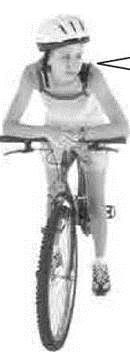
I go to the park or playground with my friends. I ride my bike. We like doing all sorts of tricks. Of course,I wear my helmet. You have to wear it when trying out new things.

I’m crazy about gaming. But my mum doesn’t want me to play as much as I’d like to. Sometimes my dad joins me and we play against each other. Then my mum really gets mad.

I play the violin. I can also play the piano but not very well. I practise two hours a day. I like the violin because it’s a very handy instrument. The best thing is playing in a school orchestra. I dream of playing in the Philarmonic orchestra one day.

5. Complete the sentences.
John likes his film club |
|
Vicky wears her helmet |
because … |
Ron’s mother gets mad |
|
Liz likes playing in a school orchestra |

a helmet ['helmıt]

to do a trick
6. Read and choose the club.
Explain your choice.
These are ads of some clubs that children from Redhill School can join in.
JUDO CLUB
Do you want to try judo?
Classes are great fun. Interested?
Well, put your name down. Last year the classes were very popular! Your name:
JOIN OUR CLUBS
ü Art club
ü S Woodwork club
ü S Chess club
ü S Photography club
ü S Sports club
ü S Music club

I can join … club.
I can take part in…. I like it because.

LISTENING
1. Listen and find out what you mustn’t do online.

2. Listen again and say if the sentences below are true or false.
1 Some parents are worried about their children who spend all day playing computer games or surfing the net.
2 When you spend too much time in front of your computer you don’t get enough exercise.
3 The Internet helps Emma with learning.
4 Posting a photo online is safe.
5 The Internet helps to download music.

6 You mustn’t watch video clips online.
7 Emma is happy to join social networking sites.
8 Emma’s classmates mustn’t join any of the chat rooms at school.
9 It’s a lot of fun to meet up with people you meet online.
10 It’s dangerous to give out any personal information on the Internet.
REMEMBER!
too / enough
There is not enough practice.
You should do enough exercises. There is too much information. There are too many computers.
3. Work in pairs. Ask and answer the questions.
1 What is the topic of the show?
2 Why does Mrs Fisher get upset?
3 What does Emma use a computer for?
4 What do Emma’s parents keep repeating?
5 Does Emma play games online?
6 What mustn’t Emma do at school?
7 Why are parents and teachers worried about safety online?
REMEMBER!
Asking for Opinion or Feelings
What do you think about it? |
I think… / I don’t think… |
because … |
|
Do you think that games are fun? |
I believe … |
Why do you think so? |
|
Why do you get upset / angry? |
Because… |
4. Look back at the sentences in task 2. Ask your partner for his / her opinion.
5. Listen and sing the song.
Show Me Your Face
I am going to send an e-mail Although I can’t see your face. I’m going to meet you some day Out in time and space.
Refrain:
Show me your face.
Am I asking much?
Out in time and space All I need is a human touch.
I’m going to search for night and day, I’m going to contact you.
Can you help me to find the way To make all my dreams come true?
Refrain.

GRAMMAR
REMEMBER!
too + adjective 1/ adverb 2(занадто)
She is too young to travel alone.
(She can’t travel alone.)
He drives too fast.
(He should not drive so fast.)
Adjective / Adverb + enough (достатньо)
This camera is good enough.
(And I like it.)
She got up early enough.
(She will come to school on time.)
1an adjective ['ædjeɔtıv] — прикметник
2an adverb ['ædv3:b] — прислівник
1. Complete each sentence with
’too’ or ’enough’ and one of the adjectives from the box.
late, heavy, cheap, fat, short, light, good
1 I can’t wear this skirt. It’s……
2 Tom can’t buy this camera. It isn’t…..
3 Winnie-the-Pooh couldn’t get through the hole. He was..
4 Let’s buy these jeans. They are…..
5 I can’t carry this suitcase. It is …
6 Where is Mike? It is …
7 Switch on the lamp. It is not …
REMEMBER!
enough too much too many |
+ Noun |
There is too much water. There are too many cars. There isn’t enough sugar. There aren’t enough books. |
2. Choose ’too’ or ’enough’ to complete the sentences.
1 There is … much music to download.
2 There aren’t … classrooms for pupils.
3 There are … many photos on their school’s site.
4 Are there … computers in the classroom?
5 She spends … much time in the Internet.
6 It is … dangerous to meet up with people you meet online.
7 I should give … personal information to take part in this activity.
8 There are … many social networking sites today.
9 There wasn’t … time to prepare for the exam.
10 There aren’t … teachers in the school.
3. Choose the correct word.
1 There are (too much /many) hotels in the town.
2 There are (too much / many) people on the plane.
3 They haven’t got (many / enough) water in the bath tub.
4 There aren’t (much / enough) hotels at the seaside.
5 I’ve got (too much / many) work to do.
6 There wasn’t (many /enough) rain last month.
7 There is (too much /many) salt in the soup.
4. Complete the sentences.
a) Use ’too’ or ’enough’ and the adjectives from the box.
sweet, small, long, warm
1 Could I have some water, please? The tea is………
2 Jane, you should get a hair cut. It’s………
3 You needn’t your coat today. It is………
4 The coffee isn’t………… ? Can I have some sugar, please?
b) Use ’too much’ or ’too many’.
1 I can’t watch the film. I’ve got … homework.
2 I can’t find the pen! There are … books on the desk.
3 I didn’t enjoy the holidays. There were … people there.
4 Don’t make … noise. I’ve got a headache.
5. Put the sentences into the proper word order.
Write them in your notebook.
1 enough we have just to get to the airport time
2 she much has work to do too
3 enough I do have money not for Australia a trip to
4 enough that not is paint room for this
5 candy give don’t too her much
6 enough she tall is not to top shelf reach the
7 enough people that’s pasta for two
8 for him much too that is to carry
9 enough is baby the warm?
10 enough I think that big for us flat is
SPEAKING
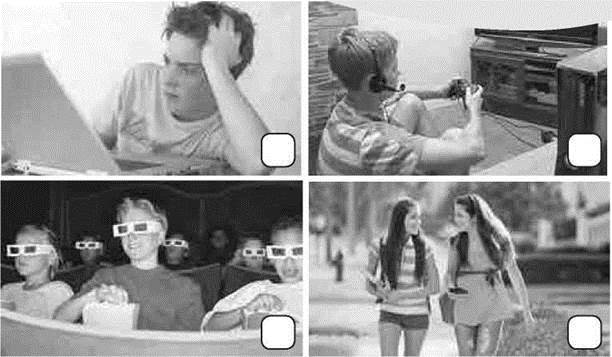
1. Work in pairs. Look at the photos and speak about each one.
✵ What activity are they doing?
✵ Is it an extra-school activity or a lesson?
✵ Do you have the same activity at your school?

2. Look at the leaflet and answer the questions.
✵ What is the leaflet about?
✵ Where could you see it?
✵ How many clubs are there?

3. Work in pairs. Talk to your partner about the clubs in Bolton Middle School you want / don’t want to join.

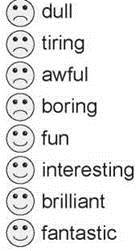
I want to join the Art Club because it’s fun. I don’t want to join the Sports Club. I think it’s tiring.

I’m afraid you’re wrong. In my opinion, Sports Club is great. I like sports activities. I’ll join the Sports Club! But I won’t join the Photography Club. In my opinion, it is boring.
REMEMBER!
Expressing |
||
Opinions |
Agreeing |
Dasagreeing |
✵ I think / |
✵ Yes, that’s right. |
✵ I’m afraid you |
suppose… |
✵ I think so, too. |
are wrong. |
✵ In my opinion. |
✵ I (quite) agree. |
✵ That’s not |
✵ I must say |
✵ That’s clear |
right. |
that. |
now. |
✵ Absolutely not |
✵ I believe that. |
✵ I disagree. |
4. Do a survey 1 about your classmates’ favourite free time activities.
Make a graph.
A: What do you most like doing in your free time?
B: I love going cycling.

1a survey [sәveı] —дослідження
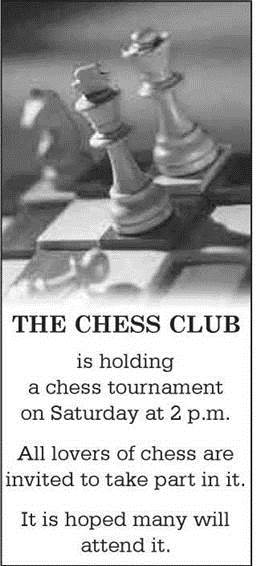
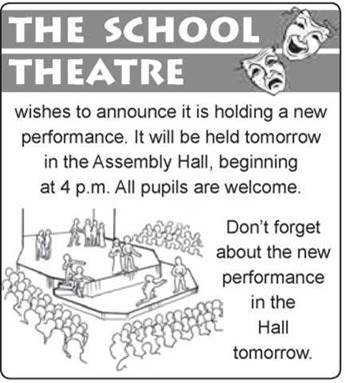
5. Look at these announcements and say what events they inform about

WRITING
1 Write some rules for the safe use of the internet. Explain them.
2Make an announcement about any extra-class activity or a school event you are going to have. Work in groups.
LOOK BACK!
1. Read and draw a plan of this small school.
The science lab is next to the toilets, and the janitor’s room is opposite the toilets. The gym is opposite the science lab and it is between the changing room and the janitor’s room. The computer room is opposite the staff room. The headmaster’s office is between the canteen and the staff room. The lockers are opposite the canteen. The library is between the computer room and the science lab. There are changing rooms opposite the library. And there is one more classroom. It is the music classroom. Where is it?
2. Fill in the sentences with the missing words from the box.
activities, the Assembly Hall, needn’t, school, theatre, lab, joined, uniform
Yesterday we visited a new… that was opened up in our town. All the pupils wear green … there. But they … wear it after classes. Extra-school … usually start at 3 o’clock in the afternoon. Lots of pupils … different clubs. The school has got an excellent … . They held performances in … . The Science Club is on Tuesdays and Fridays in the … where pupils have got their Science classes.
3. Complete with ’must’ or ’mustn’t’.
1 You … do your homework every day.
2 You … be rude to your parents.
3 You … worry about the exam.
4 We … buy some flowers for the party.
5 You … drink too much coffee.
6 You … clean your teeth every day.
7 You … drive fast.
8 You … drink a cup of milk every day.
9 You … exercise three times a week.
10 You … eat too many sweets.
4. Complete the second sentence so that it means the same as the first. Use the word in brackets.
1 This tea is very sweet. I can’t drink it. This tea is … (too) Example: This tea is too sweet for me.
2 The weather’s cold and this jacket is too light.
This jacket is… (enough)
3 You don’t need any more computer games.
You’ve got … (enough)
4 I’ve got a lot of homework to do. I can’t finish it all.
I’ve got … (too)
5 She got up late so she was late for school.
She was late for school because she … (enough)
6 You should eat more slowly.
You eat … (too)
5. a) Listen and read, then say if the teacher is a married woman. Ms Jones: Good morning, children!
Children: Good morning, Ms Jones!
Ms Jones: As you already know, I am your new form teacher. I know that you have got a lot of questions for me, so shoot! Jessica: Ms Jones, is the library open all day?
Ms Jones: Yes, it is.
Pete: Are the computer rooms on the first floor or on the ground floor?
Laura: Are our lockers next to our classroom or opposite the entrance?
Ms Jones: Ok, ok…Too many questions at once. I’ve got a plan of our school for you, so you can find your way around. Mike: Why is PE only twice a week?
Ms Jones: Well, I don’t know. But we have got six sports groups at school, so you can join in.
Laura: Are you the coach of the school volleyball team?
Ms Jones: Yes, I am.
Jessica: Is volleyball your favourite sport?

Ms Jones: Yes, it is. But I like other sports, too.
Mike: Have you got any hobbies?
Ms Jones: Yes, I have. I like cooking. I collect recipes. I’ve got 2,000 recipes from many different countries.
Mike: Have you got a pet?
Ms Jones: I have got a beautiful dog — a bobtail called Fluffy. Jenny: Ms Jones, have you got any children?
Ms Jones: No, I haven’t.
Jenny: Are you in love?
Ms Jones: Now, now… I think that’s enough about me. Now I’ve got questions for you. But first, I’II tell you a joke.
b) Choose the correct answer.


c) Work in a group of 5. Act out the talk in (a).
6. a) Before listening answer the questions.
— How often do you play computer games?
— Do you play violent games?
— Do you think that playing computer games makes children aggressive?
— Does playing computer games isolate you from others or help to make friends?
b) Listen and say what the experts are talking about.
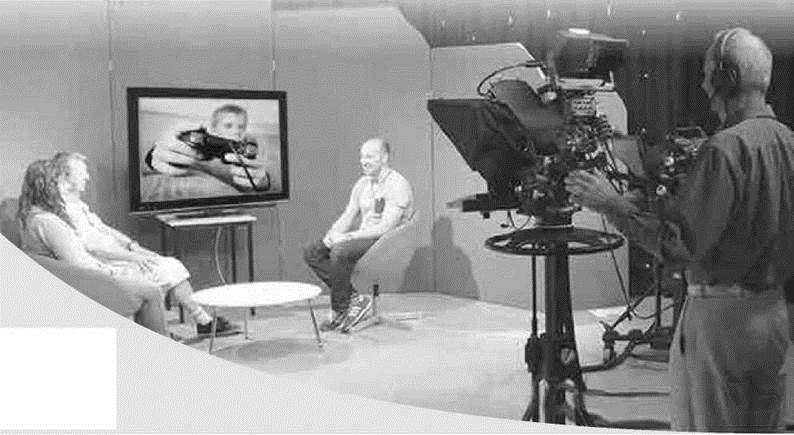
7. Listen again, then agree or disagree with the statements below. Work in pairs.
1 Parents have to set a time limit for children when they play games or surf the Net.
2 There are many good games that make children think faster or teach them new skills.
3 Games help to solve problems the children have with others.
4 Games don’t make children aggressive.
5 Sitting alone in a room isolates you from the real world and other people.
6 You needn’t hang out with other children if you have an interesting computer game to play.
8. Work in groups. Discuss the items below. Express your opinion.
а) Being online can be dangerous. Parents and teachers must warn 1 their children about the dangers in the same way they warn them when they go swimming or riding their bike.
б) You should spend a lot of time with your friends and family, having fun in different ways. The Internet is very useful as long as you use it in a clever way.
с) Parents have to set a time limit for children when they play computer g ames or surf the Net.
1to warn [wɔ:n] — попереджувати

9. Read the text and say if the sentences on page 41 are true or false.
AT THE NEWBURG SCHOOL’S INTERNATIONAL FESTIVAL

Extra-school activities are part of school life. Parents often go to their children’s schools to see their work. Sometimes the schools have exhibitions of the pupils’ art or project work. Many schools have a school choir and an orchestra and they hold concerts. The plays at the end of each school year are also very popular. Some of the parents help teachers with these activities.
Today we have been to the Newburg School in Great Britain. The school has had its annual 1 International Festival. Over 300 people enjoyed food and activities. The pupils served food from many different countries. Pupils’ groups performed at the festival. We watched African dancing. We listened to Japanese storytelling. We saw a Chinese 2 puppet show and much more. There was an international fashion show. Pupils modelled clothes from different countries. Everyone has had a great time at the festival.
Mr. Jones, the school headmaster said, "All of our pupils and teachers had worked hard over the project. I can say this year’s festival is the best we have ever had.»
1annual [ænjuәl] — щорічний
2Chinese [,tʃai'ni:z] — китайський
1 Many schools can have a school choir or an orchestra.
2 Parents never help teachers with extra-school activities.
3 Parents can see the pupils’ art or project work at school.
4 The festival takes place in the USA.
5 The pupils displayed their hobby collections.
6 Pupils performed African dancing and Chinese puppet show.
7 Pupils worked hard on the project.
8 The school headmaster modelled clothes.
9 It is the best festival the school has ever had.
10. Write a paragraph about Culture Festival you have had (or are planning to have) at your school. Use the following:
to present |
to make |
surprises |
to give |
prizes |
to choose |
decorations |
presents |
||
to work hard |
a show |
a play |
|
exhibition |
a puppet show |
|
to hold |
game to perform |
a storytelling |
concert |
a gallery of projects |
|
competition |
dancing singing |
LEARNING TIP
Develop your writing skills. This is a paragraph. The first sentence tells you what the paragraph is about. The other sentences give more information.
Example:
Alex Morgan, a 12 year-old boy, is a winner of the «Young Poets» competition. His poem is called «My Home». Alex came to Bridge Street School in October. He has been interested in writing for several years. He has written many poems and stories. This is the first time he has won a prize.

1. Listen and read.
A GIGGLE 1 BOX AND A LEAKY FAUCET 2
after Louis Sachar
Every day after lunch Mrs Jewls read a story to the class.
Dana hated stories.
The last book was the story about a pig. It was very funny. All the children laughed. Dana couldn’t stop laughing. John called her ’a giggle box’.
When Dana broke out laughing 3 at the lesson, John said: «There goes the giggle box.» She hated John.
The other story was very sad. Dana couldn’t stop crying. John called her ’a leaky faucet’. «Who will fix the leaky faucet?» he asked.
Mrs Jewls rang her bell, and all the children sat quietly. The teacher was reading a story about a little baby-animal. The story was sad because a car killed his mother.
Dana cried.
The next day Dana came up to Mrs. Jewls for a talk.
«Can I go out when you read?» asked Dana.
«Why?» asked Mrs. Jewls.
«I hate stories,» said Dana. «I laugh and cry too much.»
«You don’t hate stories, Dana,» Mrs. Jewls told her. «You love stories. I would like other children to be able to laugh and cry like you.»
«Really?» asked Dana. She always thought she hated stories when she really loved
She was glad.

1to giggle ['gıgl] — гоготати, cміятись
2a leaky faucet ['fɔ:sit] — несправний| кран (що протікає)
3to break out laughing — пирскати зі сміху
READING 4 FUN!
«Oh..!» She said.
«Well, what is it?» asked Mrs. Jewls.
«I might love John, too?»
2. Choose the right sentence according to the story.
1 a) Mrs Jewls read stories before lunch.
b) Mrs Jewls read stories after lunch.
2 a) Dana couldn’t stop laughing or crying.
b) John couldn’t stop laughing or crying.
3 a) Dana didn’t like stories.
b) Dana didn’t know she loved stories very much.
4 a) Dana didn’t really hate John.
b) Dana hated John.
3. Look at the pictures and tell the story.

Every day …

When the story was …

When …

The next day …
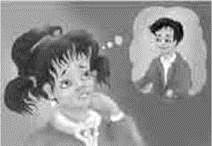
«Really?» …
4. Answer the questions.
1 What was Dana’s problem?
2 What did John mean calling her:
a) a giggle box?
b) a leaky faucet?
3 Why did she come up to her teacher?
4 How did the teacher help Dana?
My Learning Diary

The topics of this unit are
I find this unit very easy /quite easy /quite difficult / very difficult. (Underline what is true for you)
I think that the most important thing I have learnt is
The most difficult thing for me was
The things that I enjoyed most in the Unit were
The things that I didn’t enjoy were
The ways I used working with the Unit were
My favourite activities / tasks were
The new grammar I have learnt in the Unit are
The best lesson I had in my English class was
The things that are easy to read are
Photocopy for Your Portfolio
The things that are easy to listen to
The things that are easy to talk about
The things that are easy to write about
The things that are difficult to read about
The things that are difficult to listen to
The things that are difficult to talk about
The things that are difficult to write about
Three things I would like to remember from this unit are
because
I would like to improve my pronunciation /spelling / vocabulary / grammar/fluency. (Underline what is true for you.)
The things that I would like to learn are
You have finished the unit. Choose the adjectives that best describe how you feel about it.
happy |
satisfied |
frustrated |
motivated |
good |
relieved |
unhappy |
excited |
sorry |
tired |
After the unit I can:
|
NOW I CAN |
||||
✵ |
describe the interior of a school |
|||
✵ |
give directions inside the school building |
|||
✵ |
tell about school facilities |
|||
✵ |
talk about a school site |
|||
✵ |
listen and understand about school life |
|||
✵ |
discuss some information about schools |
|||
✵ |
express needs and necessities |
|||
✵ |
talk about things that are not allowed |
|||
✵ |
ask and answer about school rules |
|||
✵ |
interview others about their favourite afterschool activities |
|||
✵ |
read and understand ads about school clubs |
|||
✵ |
read and understand announcements of events |
|||
✵ |
read and understand leaflets about afterschool activities |
|||
✵ |
use ’too/enough’ to express the degree or the amount of smth |
|||
✵ |
ask for an opinion |
|||
✵ |
express my attitude to some free-time activities |
|||
✵ |
talk about online safety |
|||
✵ |
make an announcement of an extra-school activity |
|||
✵ |
write a list of rules for a safe use of the Internet |
|||
✵ |
write a paragraph about a school event |
|||
|
MY WORK |
||||
Перша публікація: 01/01/2015
Останнє оновлення: 31/12/2023
Редакційна та навчальна адаптація: Даний матеріал зведено на основі першоджерела/оригінального тексту. Команда проєкту здійснила редакційне оглядове опрацювання, виправлення технічних неточностей, структурування розділів та адаптацію змісту до навчального формату.
Що було опрацьовано:
- усунення форматних дефектів (OCR-помилки, розриви структури, дефектні символи);
- редакційне упорядкування змісту;
- уніфікація термінів відповідно до академічних джерел;
- перевірка відповідності фактичних тверджень тексту першоджерела.
Усі згадки про автора, рік видання та походження первинного тексту збережено відповідно до джерела.