Підручник Англійська мова 5 клас (5-й рік навчання) - А.М. Несвіт - Генеза 2018 рік
Unit 9. School Life
Lessons 2-3
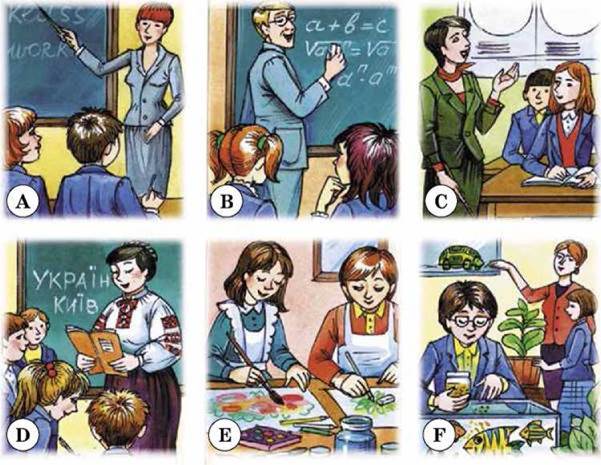
1. Look, read and match the pictures with the names of the school subjects.
___________ 1. Maths
___________ 2. History
___________ 3. Nature Study
_________ 4. Art
_________ 5. Ukrainian
___________ 6. English
2. Read and say what lessons you can hear the following sentences and questions at.
• Music • History • Art • Mathematics • Nature Study • English •
1. Ann: «Do you like speaking English?»
2. Miss Alison: «And now we are going to learn a new song.»
3. Miss Alison: «Take a ruler and draw a straight line.»
4. Dan: «When did Ukraine become an independent state?»
5. Kim: «What trees can you see in the forests in Ukraine?»
6. Alex: «Are you drawing a picture at the moment?»
3. Work in pairs. Ask and answer the questions about the subjects you have in your timetable.
Example:
A: What subjects do you have on Wednesdays?
B: On Wednesdays I have six lessons: English, Maths, Ukrainian Literature, PE, Nature Study and History.
4. Work in pairs. Ask and answer the questions about the things you use at different school lessons. Use the words from Ex. 1, page 187 and the names of the subjects in the box given below.
• English • History • Ukrainian • Maths • Nature Study • Ukrainian literature • PE •
Example:
A: What things do you use at the Art lesson?
B: At the lessons of Art I use pencils, an eraser and a pencil sharpener.
5. Work in pairs. Read the telephone conversation and answer the questions. Then make and act out similar dialogues.
• Do the children have the Art lesson on Monday?
• When do they have the History lesson?
• Which room is the History lesson in?
Ann: Hi, Jane! This is Ann speaking.
Jane: Hello, Ann!
Ann: What are you doing?
Jane: I’m writing the timetable for tomorrow.
Ann: Do we have the Art lesson tomorrow?
Jane: No, we don’t. The Art lesson is on Wednesday.
Ann: What is the first lesson tomorrow?
Jane: History is. It’s in Room 17.
Ann: Where is it?
Jane: It’s on the first floor.
Ann: Thank you. See you tomorrow then. Bye!
Jane: Bye!
6. Read and complete the text. Use the words: teacher, books, came, exercise books, blackboard, went, desk, copy books.
Peter … to school in the morning. He put his … and …into his school bag. When Peter … to school, he sat down at his … . The … came in to the classroom. She asked one pupil to write the word «Apple» on the … and the other children wrote it in their … .
Conversation Lab
7. a) Work in two groups. Talk about the school subjects. Make a graph. Use the words: easy, difficult, important, useful, fun, boring, interesting.
Example:
A: Is Maths easy? - No, it isn’t. It is difficult.
B: Which subject is boring? - I think, Nature Study is.
English |
Maths |
History |
Ukrainian |
PE |
Nature Study |
Art |
easy |
difficult |
important |
useful |
fun |
boring |
interesting |
b) Read the other group’s graph and say as in the example.
Example:
Group A thinks that Maths is easy but we think it is difficult.
8. Read and complete the gaps with the correct items A, B or C.
I’m in the fifth form now. At my school we (1) … six lessons a day, three in the morning and three in the afternoon. This year we (2) … thirteen subjects! Monday morning (3) … terrible. We have Maths for two lessons and then the Nature Study lesson. Monday afternoon is nice: we have two lessons of English and then Music. Tuesday is my favourite day. We have History and English in the morning and then Computer Studies and Art. On Wednesday we have the PE lesson in the afternoon. It’s my favourite subject. I (4) … Wednesday afternoon! Thursday is difficult. I (5)…like German but it’s useful.
Friday is OK because it is the last day of the school week. Saturday and Sunday (6) … great fun!
1 |
A has |
Bhave |
C has had |
2 |
A are studying |
Bstudies |
C study |
3 |
A is |
Bare |
C has been |
4 |
A likes |
Blike |
C liked |
5 |
A don’t like |
Bdoesn’t like |
C hasn’t liked |
6 |
A is |
Bwere |
C are |
Перша публікація: 01/01/2018
Останнє оновлення: 31/12/2023
Редакційна та навчальна адаптація: Даний матеріал зведено на основі першоджерела/оригінального тексту. Команда проєкту здійснила редакційне оглядове опрацювання, виправлення технічних неточностей, структурування розділів та адаптацію змісту до навчального формату.
Що було опрацьовано:
- усунення форматних дефектів (OCR-помилки, розриви структури, дефектні символи);
- редакційне упорядкування змісту;
- уніфікація термінів відповідно до академічних джерел;
- перевірка відповідності фактичних тверджень тексту першоджерела.
Усі згадки про автора, рік видання та походження первинного тексту збережено відповідно до джерела.