Підручник Англійська мова 5 клас (5-й рік навчання) - А.М. Несвіт - Генеза 2018 рік
Unit 2. The Clothes We Wear
Lesson 5
1. a) Work in pairs or in small groups. Complete the lists given below.
Clothes we wear at the parties: a dress, etc.
Clothes we wear every day: trousers, etc.
Clothes we wear in the gym: a T-shirt, etc.
Clothes we wear to school: a jacket, etc.
b) Compare your lists with another pair or group. Who has got a bigger list?
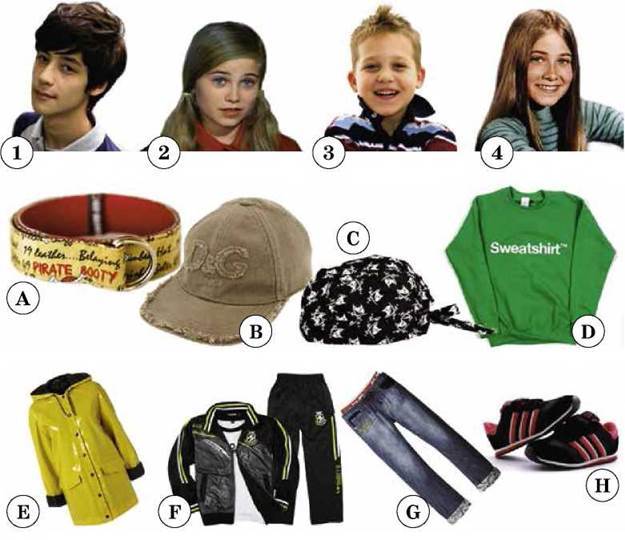
2. Listen and match the people (1-4) to the clothes (A-H) they are going to wear.
4. Listen and read.
Ann: Hi, Jane! What are you doing?
Jane: Oh, hi, Ann! We’re having a party at school. I’m choosing a dress to put on. Ann: A dress? What about this one?
Jane: It’s nice, but it’s out of the season. Ann: Then you can put on this blouse and a skirt.
Jane: A blouse and a skirt? I’ll try them on. Ann: OK. I’ll be waiting for you!

4. Work in pairs. Use the words from Ex. 1, page 37 to act out a similar dialogue.
5. Complete the texts with the words from the boxes.
✵ shirt ✵ jacket ✵ school ✵ trousers ✵ badge ✵ pocket ✵ uniform ✵
1. In the UK many pupils between 11 and 16 of age wear a formal … a tie and … for boys and a blouse, a tie and trousers or a skirt for girls. There is the school … and the name of school on the of … the jacket. Children in many UK state primary schools have a … jumper and / or polo … with the … name and logo.
✵ uniform ✵ dress ✵ shoes ✵ socks (x2) ✵ hat ✵ sandals ✵
2. In summer, I put on a pretty light green and white cotton … . I wear long white knee … or short white ankle … . Girls may wear flat brown or black … or … .The part of the summer school … is a boater-style … . We usually wear it when we go to or from school.
Перша публікація: 01/01/2018
Останнє оновлення: 31/12/2023
Редакційна та навчальна адаптація: Даний матеріал зведено на основі першоджерела/оригінального тексту. Команда проєкту здійснила редакційне оглядове опрацювання, виправлення технічних неточностей, структурування розділів та адаптацію змісту до навчального формату.
Що було опрацьовано:
- усунення форматних дефектів (OCR-помилки, розриви структури, дефектні символи);
- редакційне упорядкування змісту;
- уніфікація термінів відповідно до академічних джерел;
- перевірка відповідності фактичних тверджень тексту першоджерела.
Усі згадки про автора, рік видання та походження первинного тексту збережено відповідно до джерела.